Emerging Coffee Regions: Sourcing Guide 2026
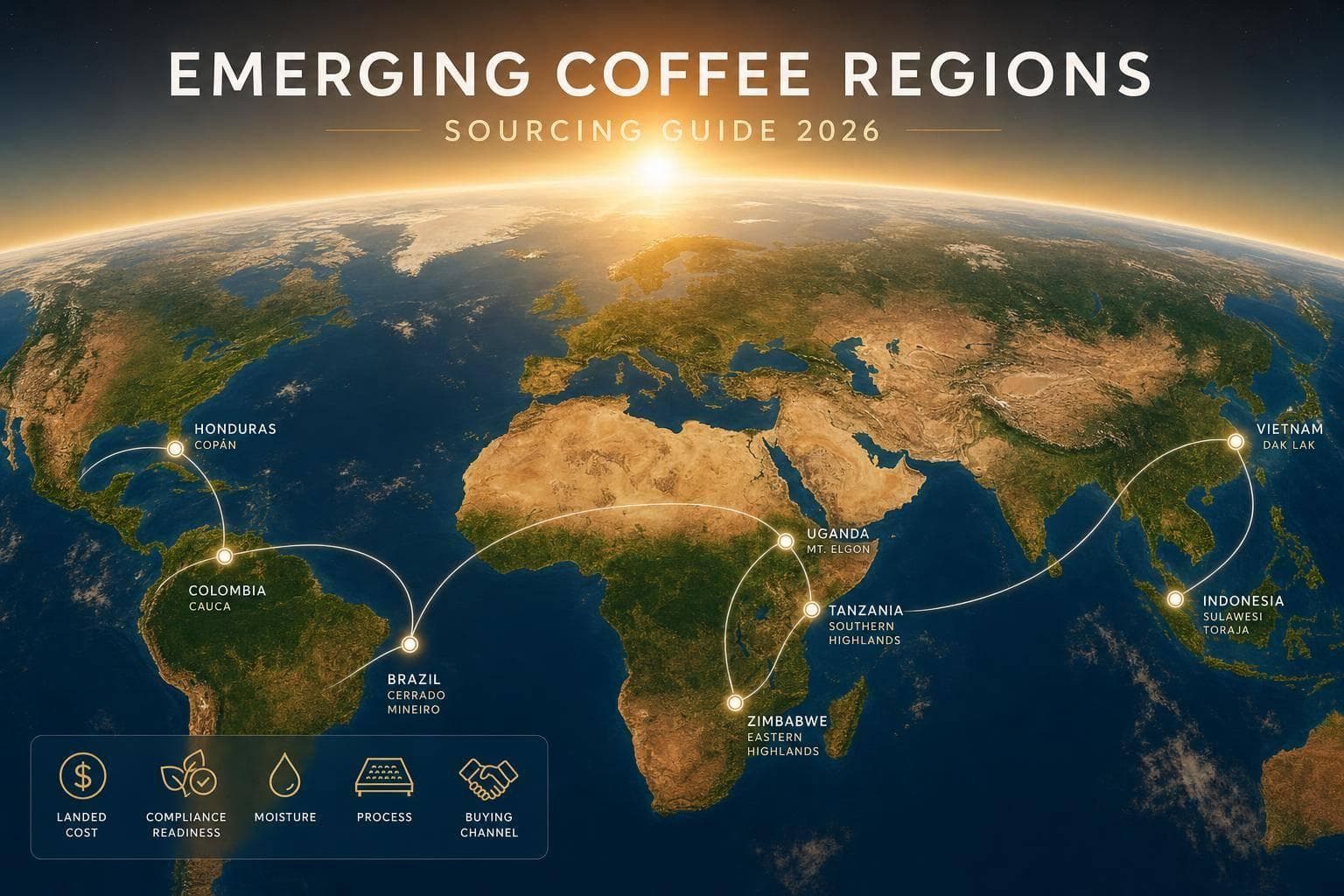
Emerging Coffee Regions: Sourcing Guide 2026
If I were buying green coffee in 2026, I would not rely on one origin. Prices are high, weather risk is hitting supply, and compliance checks now matter almost as much as cup score. My read is simple: I would use emerging regions for specific jobs in my menu, not buy them just because they are new.
Here’s the whole guide in plain English:
- Why this matters: Colombia’s production fell 29.5% in Q4 2025, and the global coffee indicator hit 332.06¢/lb in February 2025, up 94.6% year over year.
- What I would look at first: landed cost, shipping risk, moisture (10.5%–12.0%), water activity, defect counts, harvest date, storage, and EUDR geolocation data.
- How I would buy:
- use national importers for low-risk spot coffee
- use regional importers for farm-linked seasonal lots
- use direct relationships only when I can handle more capital and shipping risk
- Where I would look:
- South America: Bolivia, Peru, Ecuador
- East Africa: Burundi, Rwanda, Uganda
- Asia: Myanmar, Laos, Yunnan
- How I would use each group:
- Peru for steady blends or simple single-origin offers
- Bolivia, Ecuador, Burundi, Rwanda, Uganda Arabica, Yunnan, Myanmar for short-run filter or independent coffee roasters for café features
- Uganda Robusta for lower-cost espresso blend support
- Laos as a very small test buy
- What changes roast planning: washed lots are usually easier to manage; naturals and honeys need tighter drying checks; anaerobic lots can cup well but carry more roast and sorting risk.
- What I would build: a 3-part menu made up of core anchors, seasonal features, and limited releases.
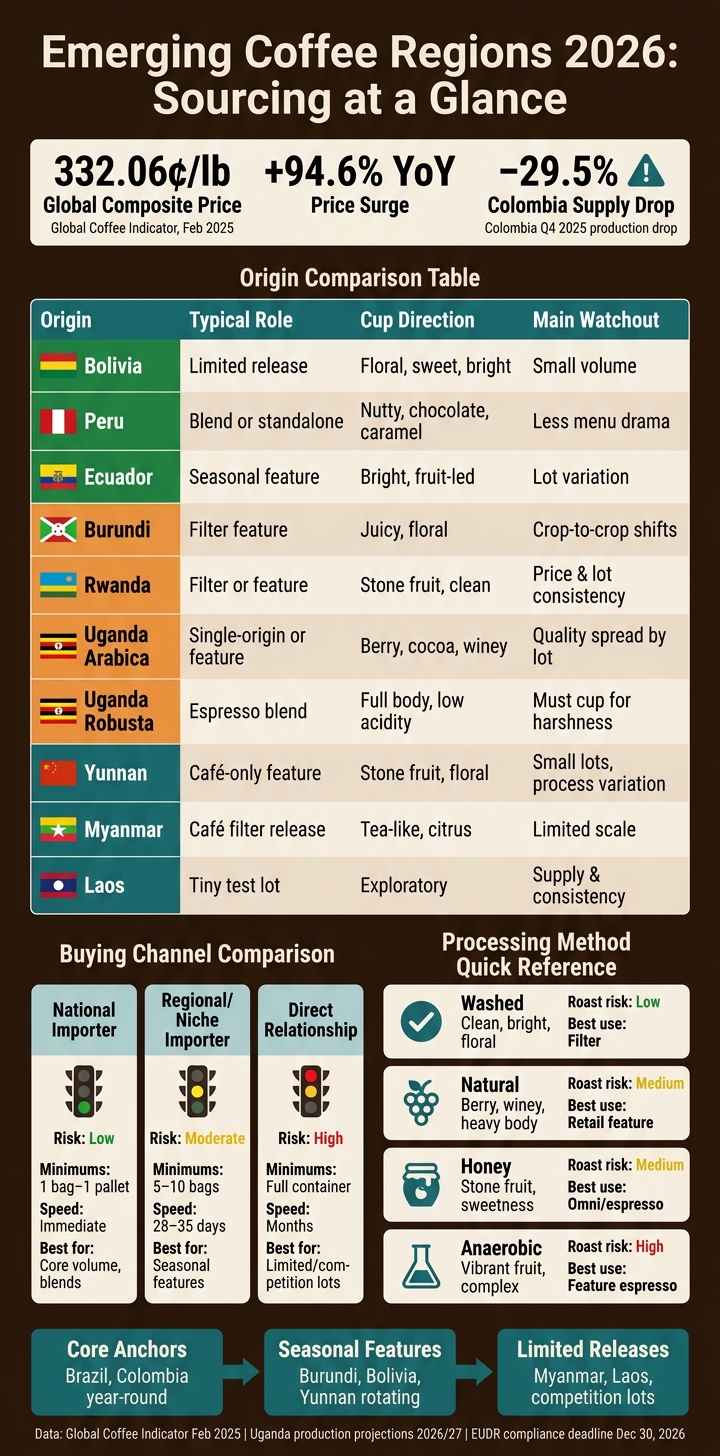
Emerging Coffee Regions 2026: Buying Guide at a Glance
From London to Yunnan: A journey into China's rising coffee origin
sbb-itb-af00fa5
Quick Comparison
| Region/Origin | Typical role | Cup direction | Main watchout |
|---|---|---|---|
| Bolivia | Limited release | Floral, sweet, bright | Small volume |
| Peru | Blend or standalone | Nutty, chocolate, caramel | Less menu drama |
| Ecuador | Seasonal feature | Bright, fruit-led | Lot variation |
| Burundi | Filter feature | Juicy, floral | Crop-to-crop shifts |
| Rwanda | Filter or feature | Stone fruit, clean | Price and lot consistency |
| Uganda Arabica | Single-origin or feature | Berry, cocoa, winey | Quality spread by lot |
| Uganda Robusta | Espresso blend | Full body, low acidity | Must cup for harshness |
| Yunnan | Café-only feature | Stone fruit, floral | Small lots, process variation |
| Myanmar | Café filter release | Tea-like, citrus | Limited scale |
| Laos | Tiny test lot | Exploratory | Supply and consistency |
My bottom line: I would judge these coffees by fit, risk, and total cost, not by origin name alone. If a lot has the right data, ships cleanly, and fits a clear menu slot, it deserves a look from a single origin and fair trade coffee specialist.
How to Read the Market and Choose a Buying Channel
Market Signals to Check Before You Buy
Before you commit to any lot from an emerging origin, start with the hard numbers.
The global composite coffee indicator averaged 332.06 US cents per pound in February 2025. That was a 94.6% jump year over year. And that’s just the base market. Origin premiums sit on top of that, so even a small differential can eat into your margin fast.
This is why landed cost matters more than FOB. FOB gives you part of the picture. Landed cost tells you what the coffee will actually cost once it reaches you. Freight, insurance, customs, and warehousing often add $1.00–$2.00 per pound, and weak logistics can push that even higher.
For 2026 buys, there’s another signal you can’t ignore: EUDR readiness. In plain English, that means asking whether the lot has GPS or polygon farm data ready to go. As of Q2 2026, only about 30% of Vietnam's coffee growing area has complete geolocation data on file. If that data is missing, the coffee may come with extra friction before it ever gets to your roastery.
Once cost and compliance are clear, the next move is picking the buying channel that fits how much risk you’re willing to carry.
Importer, Regional, and Direct Relationship Channels
The channel you choose affects minimums, traceability, sample access, and how much can go wrong. With emerging origins, this isn’t just a buying style choice. It’s a risk call.
| Feature | National Specialty Importer | Regional/Niche Importer | Direct Relationship |
|---|---|---|---|
| Minimums | 1 bag to 1 pallet (spot) | 5–10 bags (consolidated) | Full container or entire microlot |
| Traceability | Curated; varies by importer | High (farm-linked data) | Highest (direct GPS/farm data) |
| Financing | Importer carries capital/risk | Often requires L/C at sight | Roaster ties up capital in advance |
| Sample Access | Immediate (warehoused) | 3–7 days (DHL from origin) | 3–7 days (DHL from origin) |
| Risk Level | Low (quality pre-verified) | Moderate (logistics/variance) | High (crop failure/shipping) |
| Speed to Market | Immediate (spot) | 28–35 days (shipping time) | Months (harvest to delivery) |
| Best Fit | Core volume, blends | Seasonal features | Limited or competition lots |
A national specialty importer is usually the safest path if you need coffee now and want less exposure. Alternatively, you can discover independent coffee roasters who have already navigated these sourcing hurdles. A regional or niche importer can give you stronger farm-linked data, but you’ll deal with more moving parts. Direct relationship buying gives you the most control and the most farm-level detail, but it also puts more capital and shipping risk on your side.
Forward contracts can help here. They improve traceability and reduce price swings, but they also mean tighter forecasting and earlier cash commitment.
Information to Request on Every Lot
Once you’ve picked a channel, shift to the lot itself. The goal is simple: get the data that affects roast behavior, shelf life, and batch-to-batch stability.
For physical quality, ask for:
- moisture content, with a target of 10.5–12.0%
- water activity
- screen size distribution
- defect counts
These numbers help you judge whether the coffee was dried and stored well enough to hold up over long-distance shipping.
For processing and fermentation, don’t stop at the label. “Washed” or “natural” sounds useful, but it only tells part of the story. Ask for the exact fermentation method, such as anaerobic, honey, or wet-hulled, along with the drying method and how long the coffee was stabilized before milling. That information affects roast adjustments and how steady the cup will be from one batch to the next.
For traceability and freshness, confirm harvest date, crop year, farm or cooperative name, altitude in meters above sea level (masl), plus storage conditions and liner type. You should also ask for the FOB price and the estimated landed cost before you commit.
Those details shape roast planning.
Regional Buying Guide: Flavor, Risk, and Program Fit
Bolivia, Peru, and Ecuador: High-Elevation Washed and Discovery Lots
Use the lot data from the last section to sort these origins by cup profile, consistency, and volume risk. Each one plays a different role, whether you're building a core filter offer or slotting in a short-run release.
Bolivia stands out for very high elevations and very clean cups. Coffees grown above 2,000 masl - often Caturra or Gesha varieties - can bring intense sweetness, blossom aromatics, and a brightness that's hard to get elsewhere. That makes Bolivia a strong pick for limited single-origin releases where clarity and a more refined profile matter.
Peru is the safest bet of the group for many buyers. Washed lots from 1,200–1,800 masl usually land in nutty, chocolate, and caramel territory, with enough consistency to work in blends or as a simple standalone coffee. If you want an easy-drinking single-origin filter that won't surprise your regulars, Peru fits nicely.
Ecuador sits in a different lane. Washed and honey lots from 1,500–2,000 masl can show bright acidity and layered fruit, which gives you a more distinct option for menu rotation. It's a good pick when you want something a bit more expressive without moving too far off center.
| Origin | Altitude (masl) | Typical Processing | Cup Profile | Best Program Use |
|---|---|---|---|---|
| Bolivia | 1,600–2,000+ | Washed / Natural | Blossom, intense sweetness | Limited single-origin release |
| Peru | 1,200–1,800 | Washed | Nutty, chocolate, caramel | Blends / standalone |
| Ecuador | 1,500–2,000 | Washed / Honey | Bright acidity, complex fruit | Seasonal feature |
Burundi, Rwanda, and Uganda: East African Range and Blend Options
East Africa gives you range, plain and simple. Burundi and Rwanda both produce washed, fruit-forward coffees with juicy acidity and floral complexity that filter drinkers tend to love. At the same time, quality can shift from crop to crop, so it pays to cup each fresh arrival before you commit to more volume.
Uganda is an origin more buyers are taking seriously. It is Africa's top coffee exporter as of 2026, with production projected at 7.1–7.2 million bags for the 2026/27 season. That scale matters. It can open up more buying options across both Arabica and Robusta.
For espresso blends, wet-polished Ugandan Robusta can cut cost without adding harshness. That's a big deal if you're trying to hold margin and still keep the cup in line. On the Arabica side, high-elevation naturals from the Rwenzori Mountains - reaching up to 2,200 masl - bring berry and cocoa notes, while washed Bugisu lots from Mt. Elgon show winey, fruity character.
| Origin | Cup Character | Best Program Fit |
|---|---|---|
| Burundi | Juicy, floral, bright | Seasonal filter feature |
| Rwanda | Stone fruit, clean, structured | Filter offering or seasonal feature |
| Uganda (Arabica) | Berry, cocoa, winey | Single-origin filter or seasonal feature |
| Uganda (Robusta) | Earthy, full body, low acidity | Espresso blend component |
Myanmar, Laos, and Yunnan: Small-Volume Novelty Buys
These origins are best handled as intentional experiments, not program anchors. Volumes are tight, consistency can move around, and each buy usually needs more attention. Still, the upside can be high, which is why they work well for cafés that like to keep a small “what's new” slot open.
Yunnan (China) sits inside a growing specialty-production cluster, with producers using anaerobic fermentation and honey processing to produce ultra-clean cups with stone fruit and floral notes. Specialty scores in this group can reach 84–87 on the SCA scale. That gives Yunnan room to work as a café-only single origin or even an experimental espresso if the lot has enough structure.
Myanmar's Shan State offers delicate, tea-like Arabicas with bright acidity and citrus notes. That profile makes more sense as a café-exclusive filter release than as a mainline item.
Laos belongs in the same small-volume, experimental bucket and is best approached as a small test lot. Think of it less as a staple and more as a careful trial buy.
| Origin | Cup Character | Best Fit |
|---|---|---|
| Yunnan | Stone fruit, floral, ultra-clean | Cafe-exclusive single origin, experimental espresso |
| Myanmar | Tea-like, bright, citrus | Cafe-exclusive filter release |
| Laos | Small-volume, exploratory | Tiny exploratory buy |
Processing style will decide how each of these lots roasts, fades, and scales.
Processing Trends and Roast Planning for 2026 Contracts
How Processing Methods Affect the Cup
Once you know the origin and process, lock in roast risk and storage specs before you sign the contract. Processing data should shape roast planning from the start. That means drying method, moisture, water activity, and liner type aren't side notes. They should guide how you buy and how you plan to roast.
Washed lots are usually the safest buy. They tend to deliver clean, bright, floral cups that work well for filter menus and single-origin releases.
Naturals and honeys usually bring more body, sweetness, and fruit. That makes them a good match for seasonal retail launches and espresso blends. But drying discipline at origin matters a lot. A natural that wasn't dried with care can show up with unstable moisture.
Anaerobic lots can be lively and layered, but they come with the most roast risk. For sample roasts, start with a lower charge temperature and a slower rate of rise during the drying phase, since first crack can be less predictable.
Sample Roasting, Production Adjustments, and Fade Risk
Before you commit to volume from a new origin, run a structured sample roast. Start with an Agtron 55 sample roast and cup at least five bowls. This gives you a clean way to spot issues early, whether that's phenolic or medicinal notes in anaerobics, fermentation die-back in washed lots, or mold caused by weak drying or storage.
When you move into production, denser coffees grown at higher altitude need more heat early in the roast. Coffees from Uganda or Bolivia grown at high elevation are denser, so they need more energy up front to develop evenly.
Fade risk matters, especially for emerging-origin lots that travel long distances. Check moisture content as soon as the coffee lands, and keep it in the 10.5%–12.0% range. Water activity should stay below 0.60 to limit microbial growth in transit. It's also smart to write hermetic liners like GrainPro or Ecotact into the contract.
Fresh coffee should look blue-green and smell grassy. If the color looks pale, or the aroma leans straw-like or woody, that's a sign of age.
Processing-to-Roast Decision Matrix
| Process | Likely Cup Profile | Roast Challenges | Watch For | Best Use |
|---|---|---|---|---|
| Washed | Clean, bright, floral, tea-like | Maintaining acidity without over-roasting | Brown centers from stalled development | Filter |
| Natural | Berry, winey, heavy body, spice | Uneven heat absorption; drying instability | Flat or woody flavors from moisture re-absorption | Retail feature |
| Honey | Stone fruit, honey sweetness | Managing sugar browning and caramelization | Inconsistent mucilage removal | Omni/espresso |
| Anaerobic | Vibrant fruit, complex, clean | High roast risk; unpredictable development | Phenolic (medicinal) notes if sorting is poor | Feature espresso |
Use this matrix to line up each lot with the right slot in your lineup, whether that's filter, espresso, or a limited feature.
Building a Retail or Wholesale Program Around Emerging Origins
Mixing Stable Origins with Seasonal Feature Coffees
Once a lot passes quality and logistics checks, give it a clear job in the program. The cleanest 2026 setup uses two tiers: core volume and seasonal features.
For core volume, steady origins like Brazil Cerrado Mineiro or Colombia Huila can anchor year-round espresso blends and help keep wholesale supply steady. For the seasonal tier, emerging origins like Yunnan, Burundi, or Bolivia fit better as discovery lots that help a menu stand out and support higher retail margins. In the U.S., single-origin retail pricing for high-scoring microlots can land in the $40–$70/lb range.
This setup also makes customer education much easier. If your core offer stays the same, you can use the feature slot to bring in a new region without throwing off a customer's usual order. A clean washed Rwanda lot, for example, is a practical way to introduce stone fruit and floral notes to a filter-focused audience without taking your espresso blend off the menu.
Planning Volumes, Costs, and U.S. Storage Logistics
After that, size the order around the sales channel and the storage you can support. Don’t lean only on per-pound quotes. Build from landed cost instead. Freight, insurance, customs duties, warehousing, and financing can add $0.50–$1.00/lb on top of the green price. That gap can change how you price retail bags or quote a wholesale account.
For volume planning, start small. A 5–10 bag sample-commercial order is a smart way to test a new origin like Burundi before making a bigger commitment. Full container economics get much better at 60 bags or more, so that level makes more sense for origins you’ve already checked closely. Before buying, line up order size with warehouse space and pallet minimums.
The channel you choose also shapes your margin mix. Importer-held spot coffee is easy to work with and comes with logistics help, but you’re choosing from a set portfolio. For standout seasonal microlots, direct trade or forward contracts give you more control over quality and traceability, but they demand tighter forecasting. In June 2026, Dakota Graff, Director of Coffee at Onyx Coffee Lab in Arkansas, moved the company to a 99% forward-buying model to counter spot market volatility, using line-item forecasting for every blend component to avoid holding past-crop inventory.
Using Small Coffee Roasters to Study Program Fit
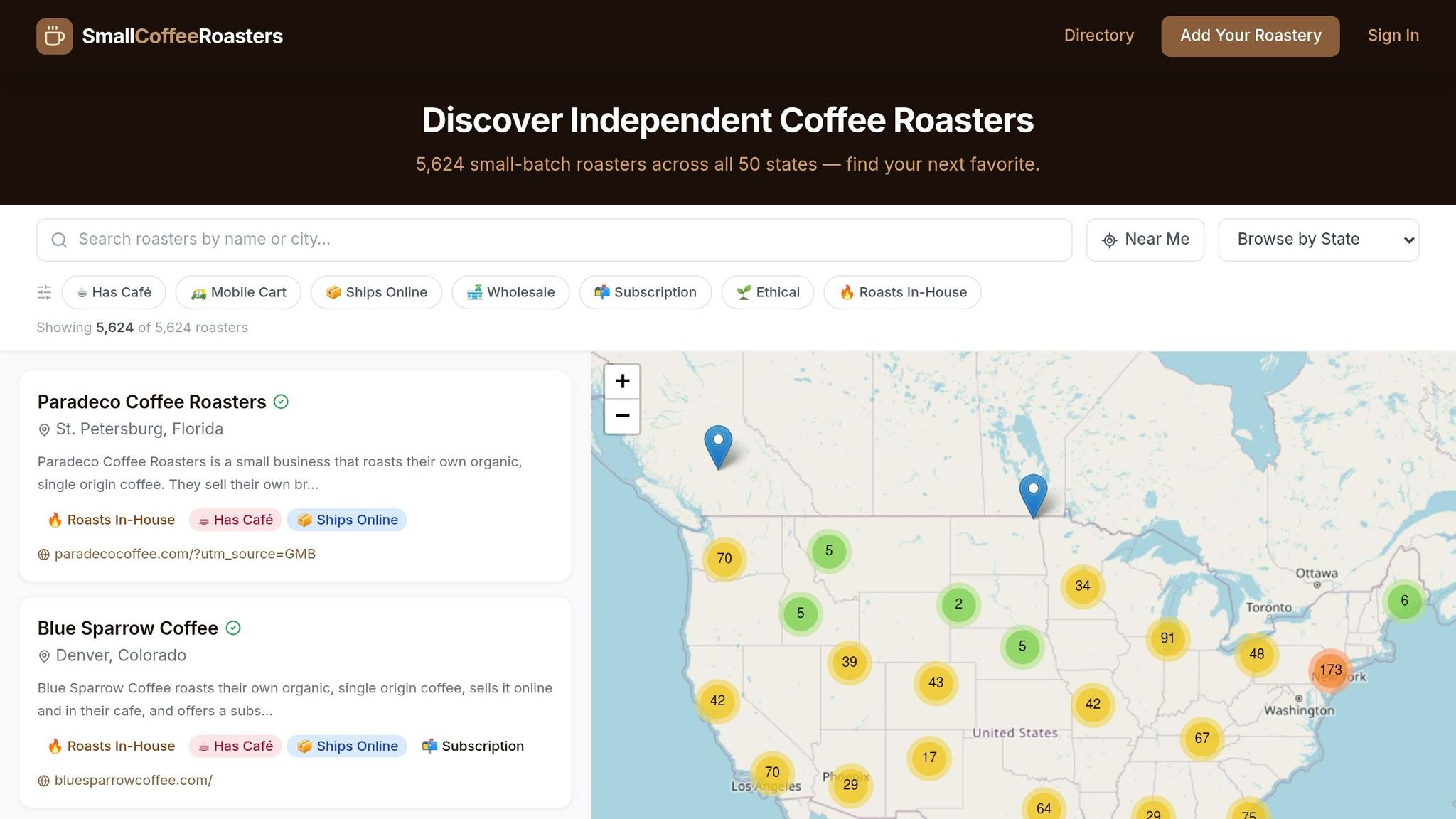
Use Small Coffee Roasters, a directory of 5,624 independent U.S. roasters, to benchmark core-to-feature ratios, retail versus wholesale mix, and seasonal rotation. That view can help you decide how much of your lineup should stay core and how much should rotate through the year.
Conclusion: A Sourcing Framework for Emerging Regions
Once you've picked your regions, buying channel, and process, one final step matters most: give each lot a clear role. Emerging origins tend to work best when every lot has a specific job, matched to the right program slot and priced on landed cost.
For 2026, buy based on cup profile, logistics risk, landed cost, and end use - not origin hype.
Your buying channel affects cost, risk, and control. Spot buying is a good fit for testing. Forward contracts make more sense for proven programs. Either way, things run better when feedback makes its way back to producers.
Don’t anchor on FOB price alone. Freight, insurance, duties, and warehousing can add $0.50–$1.00/lb. That gap can change the math fast.
The market is getting tighter. EUDR becomes mandatory on December 30, 2026 for large operators, and climate-driven production shifts are pushing coffee into higher-altitude zones. That’s why it makes sense to set up a framework now:
- core anchors
- seasonal features
- limited releases
Roasters that define roles early can buy with more confidence and move faster when the right lot shows up.
Define the role, price the landed cost, and buy for fit - not novelty.
FAQs
How do I calculate landed cost?
Landed cost is the total cost of getting green coffee into your warehouse and ready to roast. That means more than the purchase price. It also includes freight, insurance, duties, customs fees, warehousing, and financing costs.
When you review a quote, ask your supplier what’s included and what will be billed on the side. Some costs don’t show up right away, like logistics add-ons, palletization, and carrying costs tied to transit time.
The key is simple: compare offers by final landed cost, not just the price per pound.
Which emerging origin is best for blends?
Temanggung, Indonesia is one of the standout origins for blends in 2026. Its Fine Robusta and specialty-grade Arabica bring a full-bodied, layered base with a tobacco-spice character, which makes them a strong fit for premium espresso blends.
For bulk espresso blends, Vietnamese Robusta is still the go-to choice for consistency and lower cost. If you want a more fruit-forward, rounded cup, Zambia brings extra complexity with less acidity than some East African origins.
When should I buy direct instead of through an importer?
Buy direct from origin if you want deep traceability, exclusive lots, or a long-term relationship that helps with experimentation and quality gains. That route makes the most sense when your business can take on extra logistics, cash-flow pressure, and regulatory risk.
For core volume, importers are often the better choice. They give you steady access, more manageable lead times, plus storage and logistics support. Many roasters use both.