LCL vs FCL for Green Coffee: Cost and Risk
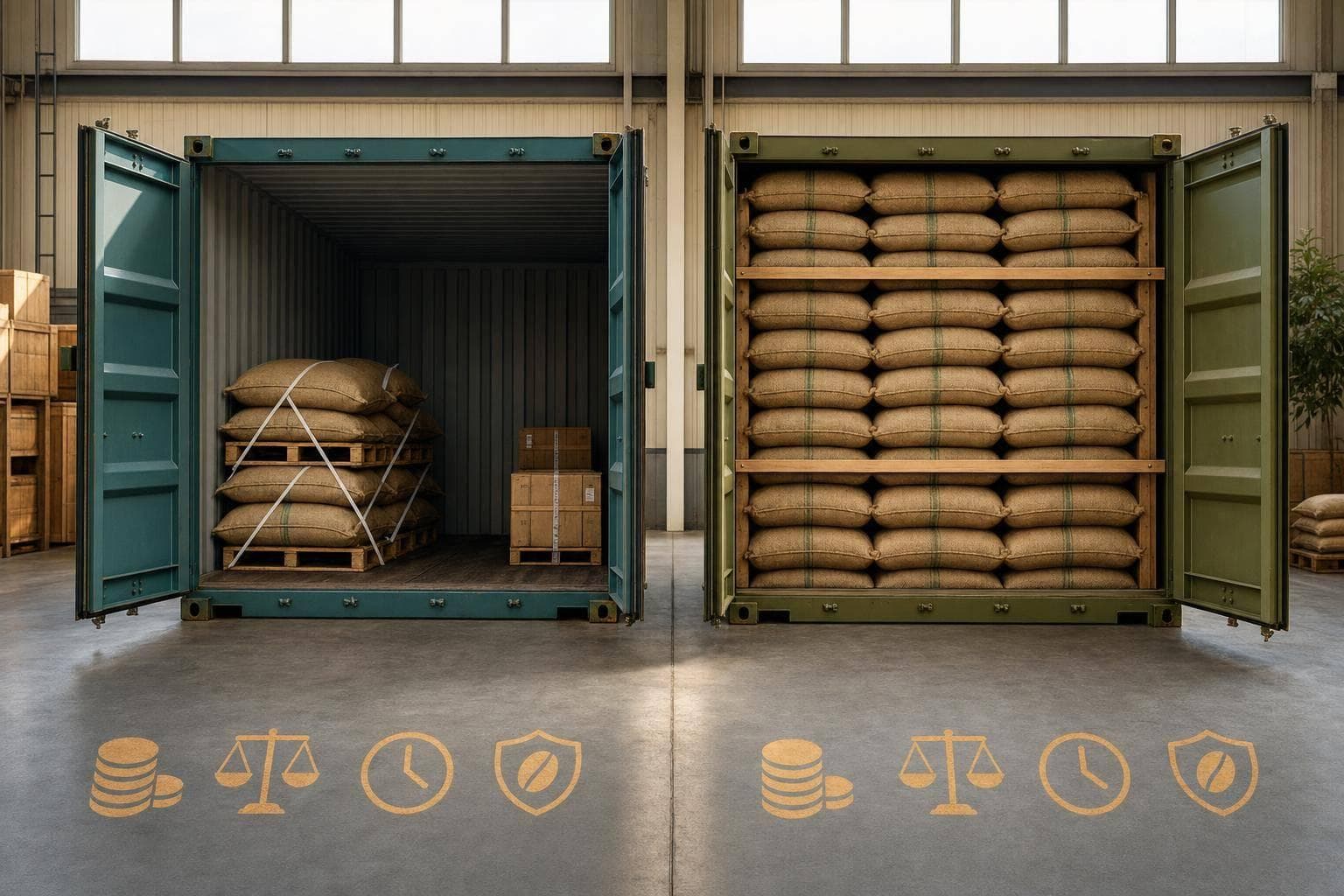
LCL vs FCL for Green Coffee: Cost and Risk
If you're shipping small lots, LCL often fits your volume. If you're moving steady, larger volumes, FCL often cuts cost per bag and lowers handling risk. That’s the short answer.
Here’s what I’d look at first:
- Cost per bag: FCL gets cheaper as you fill the container. A 20-foot container can hold about 280 to 300 bags of 60 kg coffee.
- Break-even point: LCL often works better for about 10 to 100 bags. FCL starts to look better as you get closer to container volume.
- Transit time: LCL usually takes longer because it must be consolidated and later unpacked at a CFS.
- Quality risk: LCL has more handoffs, which means more chances for bag damage, odor pickup, and moisture exposure.
- Cash and storage: Even if FCL lowers per-pound freight, it can tie up more cash and take more warehouse space.
A simple example: if a $4,000 container holds 300 bags, freight is about $0.10/lb. If that same container holds 250 bags, freight goes to about $0.12/lb. That small gap can add up fast across a full buy.
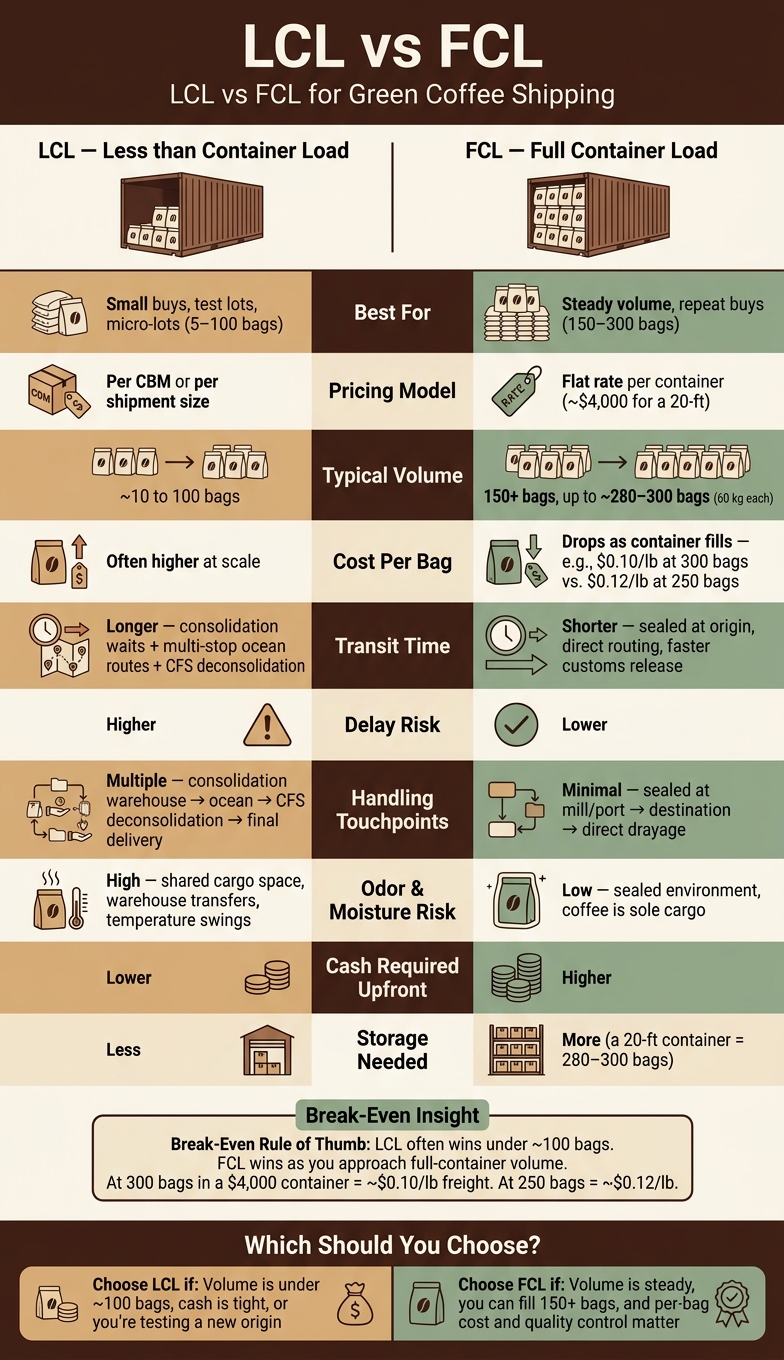
LCL vs FCL for Green Coffee: Cost, Risk & Transit Comparison
FCL vs LCL Shipping: When to Switch (Break-Even Point Explained)
sbb-itb-af00fa5
Quick Comparison
| Factor | LCL | FCL |
|---|---|---|
| Best for | Small buys, test lots, micro-lots | Steady volume, repeat buys |
| Pricing | Per CBM or shipment size | Flat rate per container |
| Usual volume | About 10 to 100 bags | Often 150+ bags, up to container capacity |
| Transit time | Often longer | Often shorter |
| Delay risk | Higher | Lower |
| Handling | More touchpoints | Fewer touchpoints |
| Odor/moisture risk | Higher | Lower |
| Cash required | Lower upfront | Higher upfront |
| Storage needed | Less | More |
| Cost per bag | Often higher at scale | Drops as the container fills |
Bottom line: if you need flexibility, LCL can work for independent coffee roasters. If you want lower per-bag freight, fewer delays, and tighter control over coffee condition, FCL often wins once your volume is high enough.
Cost per Bag: When LCL Is Cheaper and When FCL Is Not
How to Calculate Landed Freight Cost per Bag
For small roasters, the number that matters most is landed freight cost per bag. Not the ocean quote by itself.
The formula is simple:
Total Logistics Cost ÷ Total Bags Received
That means you need to include every single charge tied to the shipment:
- Ocean freight
- Origin charges
- Destination charges
- Container Freight Station (CFS) fees
- Drayage
- Chassis fees
- Inland delivery to your warehouse
Leave one of those out, and your margin math can go sideways before the coffee even hits the roaster. The point of landed cost is simple: it reflects what you actually paid to get green coffee into your building. Once you look at the full number, the LCL vs. FCL choice gets a lot easier to judge.
LCL Cost Drivers vs FCL Cost Drivers
LCL pricing is usually based on volume, often per cubic meter (CBM). That can make the first quote look cheaper than it ends up being.
Why? Because LCL costs often swell at destination. CFS handling, deconsolidation, and last-mile delivery can add up fast.
FCL works differently. You usually pay a flat container rate, then fixed port and customs fees that often land around $1,500 to $2,000 per container. Since that cost structure is flatter, your per-bag cost drops as you load more bags into the container.
| Cost Driver | LCL | FCL |
|---|---|---|
| Pricing basis | Per CBM or per bag | Flat rate per container |
| Origin handling | Consolidation at a CFS | Direct loading at origin |
| Destination handling | Deconsolidation, CFS fees | Port drayage, chassis fees |
| Inland delivery | LTL rates per pallet or bag | Full container drayage |
Break-Even Thinking for Small Roasters
The break-even point comes down to how full the container is.
Take a $4,000 20-foot container carrying 300 bags. In that case, the freight cost works out to about $0.101 per pound. Drop that load to 250 bags in the same container, and the cost climbs to $0.121 per pound - roughly $0.02 more per pound.
That’s the heart of the decision.
LCL often makes more sense when you're shipping fewer than about 100 bags and you're nowhere near filling a container. FCL usually comes out ahead as you get close to full-container volume, especially after you account for CFS and deconsolidation fees that may not stand out in an LCL quote at first glance.
Use landed cost per bag to compare quotes at the same shipment volume. That gives you an apples-to-apples view. And don’t treat cost as the whole story. Transit time and handling risk can wipe out a small freight savings fast.
Transit Time and Delay Risk: Why LCL Usually Takes Longer
Transit time is where LCL and FCL start to look very different. A small freight savings can vanish fast if a delay forces an emergency spot buy. For small roasters, schedule reliability can matter just as much as freight cost.
Why FCL Often Moves More Directly
With FCL, one exporter fills the container, seals it at origin, and keeps it sealed until it reaches the destination. That means fewer handoffs and a simpler release process. In most cases, FCL clears faster because the container stays closed and moves as one shipment.
Where LCL Delays Commonly Happen
LCL adds steps on both sides of the trip, and each one can slow things down.
At origin, your coffee goes to a consolidation warehouse and waits until the logistics provider has enough cargo from other shippers to fill a container. During ocean transit, LCL containers often move on a multi-stop route, with stops at several ports to load and unload other cargo before reaching the final destination.
Once the container arrives in the U.S., it usually goes to a Container Freight Station (CFS) for deconsolidation. In plain English, that means the container is unpacked and the separate lots are sorted before final delivery is booked. That sorting work, plus truck scheduling, adds more time. And it doesn't always follow a clean schedule. When roast plans are tight, those extra days can hit hard.
| Transit Step | FCL | LCL |
|---|---|---|
| Origin handling | Sealed at mill or port; ships when ready | Waits for consolidation with other cargo |
| Ocean transit | Usually direct between major ports | Often follows multi-stop routes |
| U.S. arrival | Clears customs; ready for direct drayage | Goes to a CFS for deconsolidation |
| Final delivery | Trucked directly to roastery or warehouse | Booked after sorting at CFS |
How Shipping Mode Affects Roast Planning and Inventory
Unpredictable transit times can create a mess for roasters running lean inventory. If a shipment slips, they often have to fill the gap with higher-priced domestic spot coffee. And if a certain origin gets held up, they may need to adjust blends or roll out other single-origin options to keep product on hand.
The safer move is to plan 3 to 6 months ahead so you have room for these logistics lead times. It also helps to keep a small local buffer for delays. That buffer matters even more with LCL, since there are more points where cargo can slow down, get bumped to a later sailing, or be rerouted. And transit time isn't the only issue here. Handling risk matters too.
Damage and Quality Risk: Handling, Odor Exposure, and Container Security
Green coffee can show up on schedule and still arrive in rough shape. The damage often comes from handling, moisture, or odor pickup along the way. And that’s the key issue here: the more a shipment gets moved around, the more chances there are for quality to slip. FCL and LCL deal with that risk in very different ways.
Why FCL Usually Lowers Damage Risk
With FCL, the container is sealed at origin and stays sealed until it reaches destination. That usually means fewer handoffs and fewer chances for torn bags, fallen stacks, or other physical damage. It’s a simpler chain of custody, which is exactly what you want with green coffee.
A smart move is to ask for stuffing photos of both the empty container and the sealed container. That gives you proof it was clean and packed the right way. You can also check that the seal number on the Bill of Lading matches the seal on arrival. If those numbers don’t match, that’s a red flag for unauthorized handling.
LCL works differently, and that’s where the risk starts to climb.
Why LCL Carries More Quality Risk
LCL creates more touchpoints because the shipment is consolidated and later deconsolidated at warehouses. Every transfer adds another shot for bags to rip, stacks to shift, or coffee to pick up humidity and ambient odors.
Green coffee absorbs moisture and smells pretty easily. In an LCL shipment, coffee may sit next to cargo with strong chemical or perfume odors, and those smells can make their way into the cup. That’s not a small issue. A clean coffee can lose its profile because it spent part of the trip near the wrong freight.
Temperature swings add another problem. They can create condensation inside containers. Green coffee needs to stay in range, because condensation and high humidity can trigger fermentation or mold. Once that starts, the problem isn’t just cosmetic. It can change the coffee itself.
| Risk Factor | FCL | LCL |
|---|---|---|
| Handling risk | Minimal - container stays sealed from origin to destination | High - multiple transfers at consolidation and deconsolidation points |
| Odor contamination | Low - coffee is the sole cargo in a controlled environment | High - shared space with potentially odorous cargo |
| Container security | High - single bolt seal for the entire journey | Lower - more handoffs and repacking increase risk |
| Moisture exposure | Managed through liners and tight stuffing to reduce airflow | Elevated due to increased exposure during warehouse transfers |
For LCL shipments in particular, hermetic liners like GrainPro or Ecotact inside jute bags can help protect green coffee in transit. They create a barrier against moisture, oxygen, and outside odors. That matters most for small-batch coffee roasters leaning on LCL and trying to reduce the added risk that comes with extra handling.
Those quality gaps become a lot more important once you start thinking about how much inventory risk you’re willing to carry.
Which Option Fits Small Roasters - and What to Decide Before You Book
Once you’ve got a clear handle on cost, transit, and quality risk, the booking call usually comes down to three things: volume, cash flow, and storage.
When LCL Makes Sense for Smaller Buying Programs
LCL is often the practical move when your volume won’t fill a container, cash is tight, or you’re still figuring out whether a coffee will sell.
That’s especially true when you’re testing a new origin or buying micro-lots. In many cases, total farm output might be only 5 bags. In that situation, booking a full container just doesn’t make sense. LCL gives you room to try different origins without tying up a big chunk of cash in one shipment.
Storage matters too. A standard 20-foot FCL can hold about 280–300 bags. For many independent roasters, that’s far more coffee than they can store, move, and roast through without stress.
Once a coffee turns into a steady, repeat purchase, the math starts to change.
When FCL Makes Sense for Growing Roasters
FCL starts to make more sense when demand is steady and you can fill at least half a container with one origin. As container use goes up, the freight cost per bag comes down. Put simply, FCL gets more attractive when fixed shipping charges are spread across more bags.
There’s also a control piece here. With FCL, you get a tighter chain of custody from origin to destination. If you’re building a dependable core coffee program and need both quality and per-pound cost to stay steady, that extra control can help you restock with fewer surprises from one order to the next.
Key Points to Check Before Booking
Before booking, compare the full landed cost, then pressure-test it against lead time and storage.
Look at:
- Total landed cost per bag, including freight, insurance, port fees, and customs brokerage
- Transit reliability, plus enough buffer in your roast planning
- Storage capacity and how much cash will be tied up in inventory
Be blunt with yourself here. If your space is limited or too much cash would sit on the floor as green coffee, that’s a strong sign LCL may fit better right now. If demand is steady and you can move volume with confidence, FCL may start to look like the better buy.
FAQs
How do I find my LCL vs FCL break-even point?
Compare your total shipping costs for LCL and FCL. That means looking at LCL consolidation fees, FCL full-container rates, and any accessorial charges that can sneak into the final bill.
The break-even point changes by route and current freight rates, but it often lands around 8 to 10 metric tons. To find your own number, look at your per-unit transportation cost and how well you’re using the space you pay for.
What extra LCL fees should I watch for?
Watch for consolidation fees. They’re a normal part of LCL quotes because your coffee is packed together with other buyers’ orders.
LCL also comes with extra handling charges. So even if the upfront quote looks smaller, the cost per bag is often higher than with FCL.
When you calculate your total landed cost, make sure you include:
- Your share of freight
- Insurance
- Local port handling
- Customs clearance fees
That way, you’re looking at the full picture instead of just the shipping quote.
How can I protect green coffee in LCL shipments?
Use high-quality packaging to cut the risks that come with shared container space. Hermetically sealed, multi-layer barrier bags give coffee the best shield against moisture, oxidation, odors, and contaminants during transit.
It also helps to bag coffee only after it has fully cooled following milling. If coffee goes into storage while it's still warm, it can lose quality fast. Some people describe this as pre-cooking the beans.