Ultimate Guide to Buying Wholesale Coffee from Small Roasters
Ultimate Guide to Buying Wholesale Coffee from Small Roasters
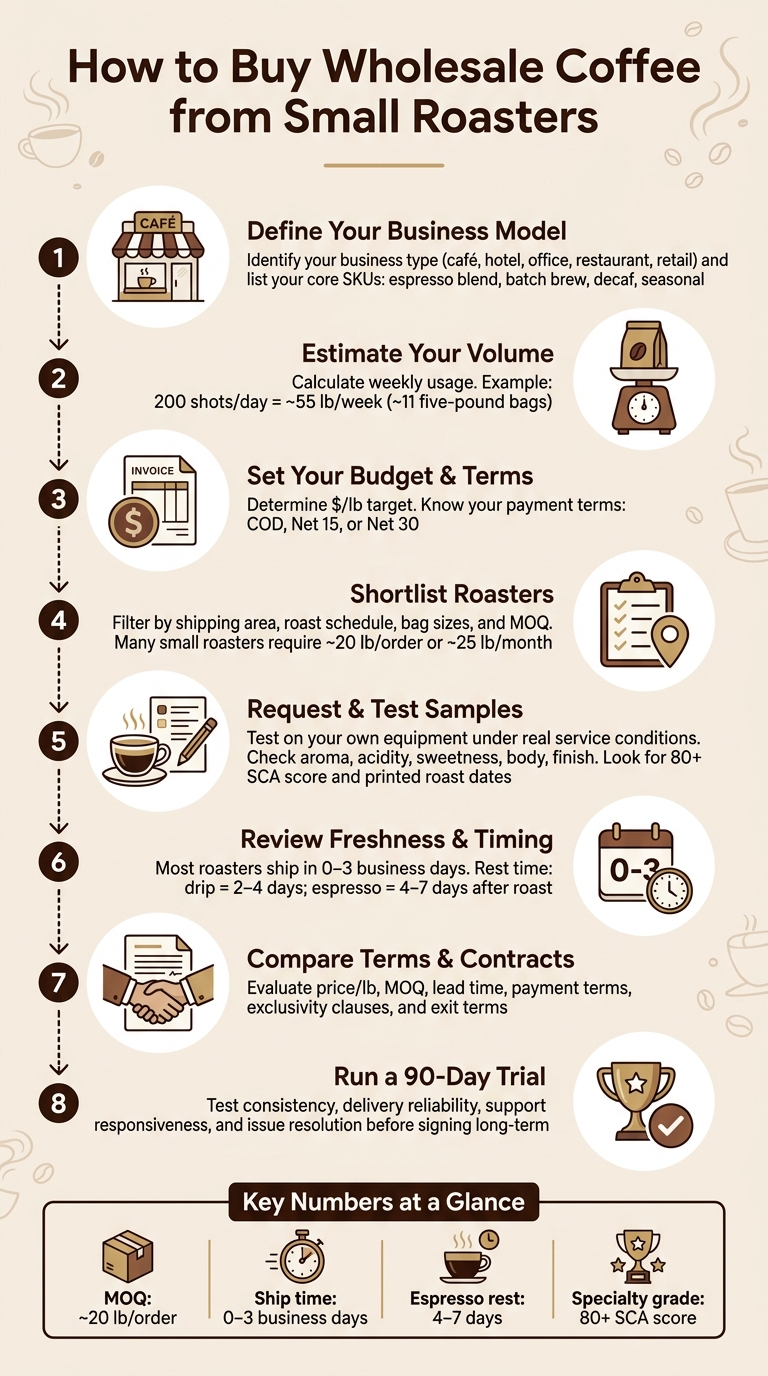
Buying wholesale coffee gets easier when I narrow the choice to four things: menu fit, weekly volume, landed cost, and roaster support. If I know my core SKUs, estimate usage, test samples on my own equipment, and compare terms like MOQ, lead time, and payment windows, I can make a clean decision without wasting time.
Here’s the short version:
- I start with my business model: café, hotel, office, restaurant, or retail.
- I list the coffees I need: espresso blend, batch brew, decaf, and seasonal options if needed.
- I estimate weekly use. For example, 200 espresso shots a day = about 55 lb. per week.
- I set a budget in $/lb. and check terms like Net 15 or Net 30.
- I screen roasters by shipping area, roast schedule, bag sizes, and monthly or per-order minimums.
- I test samples in service, not just in a tasting.
- I review roast dates, spec sheets, support, and contract terms before saying yes.
- I use a 90-day trial to compare consistency, delivery, and issue handling.
A few checkpoints matter most:
- MOQ fit: many small roasters set minimums around 20 lb. per order or 25 lb. per month
- Ship timing: many roast and ship in 0–3 business days
- Rest time: drip often tastes best after 2–4 days; espresso often does better after 4–7 days
- Quality mark: specialty coffee usually starts at 80+ SCA score
If I had to reduce the whole process to one line, it would be this: pick the roaster that fits my volume, shows clear sourcing info, ships on time, and performs well in my shop week after week.
| What I check first | What I want to know |
|---|---|
| Menu fit | Can one roaster cover espresso, drip, decaf, and retail if needed? |
| Volume | Do my weekly needs fit their minimums and roast schedule? |
| Price | What is the cost per lb., and what support is included? |
| Timing | When do they roast, ship, and deliver to my location? |
| Coffee quality | Does it taste good on my equipment across multiple batches? |
| Terms | Are payment, trial period, and exit terms clear? |
Below, I’d walk through that process step by step so I can choose with fewer surprises.
How to Buy Wholesale Coffee from Small Roasters: Step-by-Step Guide
Find the Right Wholesale Coffee Roaster for Your Business | Path Coffee Roasters Program Explained
sbb-itb-af00fa5
Define Your Coffee Program Before Contacting Roasters
Before you reach out to roasters, get clear on four things: demand, your target wholesale price, the quality level you want, and any support services you expect, like training, equipment help, or menu guidance.
Match Coffee Choices to Your Business Model
Your business model drives almost every coffee choice.
A high-volume café usually needs a blend that still tastes good in milk. A hotel breakfast service, bakery, or office coffee bar may need a steady brewed coffee setup, with decaf on hand if guests expect it. A specialty-led program may lean toward single-origin coffees or lighter roasts.
Write down your core SKUs before making contact. For example:
- A dedicated espresso blend
- A batch brew option
- Decaf
- Seasonal rotations
Or maybe you only need one or two SKUs to get started. Either way, sorting this out early helps you skip roasters whose lineup doesn’t fit your program.
Some full-service roasters also help with equipment, recipes, and barista training. If that matters to you, make it part of your partner checklist from the start.
Estimate Volume, Budget, and Storage Limits
Start with weekly usage. That number affects MOQ fit, reorder timing, storage space, and cash flow.
Here’s a simple example: 200 espresso shots per day comes out to about 7.9 lb of coffee per day, or about 55 lb per week. That’s roughly 11 five-pound bags. Those numbers give you something concrete to use when you talk through order minimums and delivery schedules.
Then set a wholesale budget based on your target margin and how often you plan to order. Common payment terms include NET15 and NET30, which mean you pay 15 or 30 days after the invoice date. You should also set a freshness window that fits your service style, especially for espresso.
Set Sourcing and Brand Priorities
Decide early whether things like sustainability, Fair Trade, USDA Organic, traceability, or B Corp certification matter to your customers.
These aren’t just marketing details. They help narrow your list of possible partners.
Single-origin coffees can help you tell a more specific origin story. Blends make sense when you want consistency as green coffee shifts with the seasons. The goal is simple: find partners whose sourcing story and communication style match the kind of experience you want to sell.
Use those priorities to build a focused shortlist. Then compare roasters that fit your service model, volume, and sourcing goals.
Find and Shortlist Small Roasters That Fit Your Needs
With your buying criteria set, it’s time to build a shortlist of roasters worth contacting. The goal here is simple: turn your requirements into a tight list by screening for location, shipping range, and product fit. Keep it short and targeted.
Use Small Coffee Roasters to Build Your Shortlist
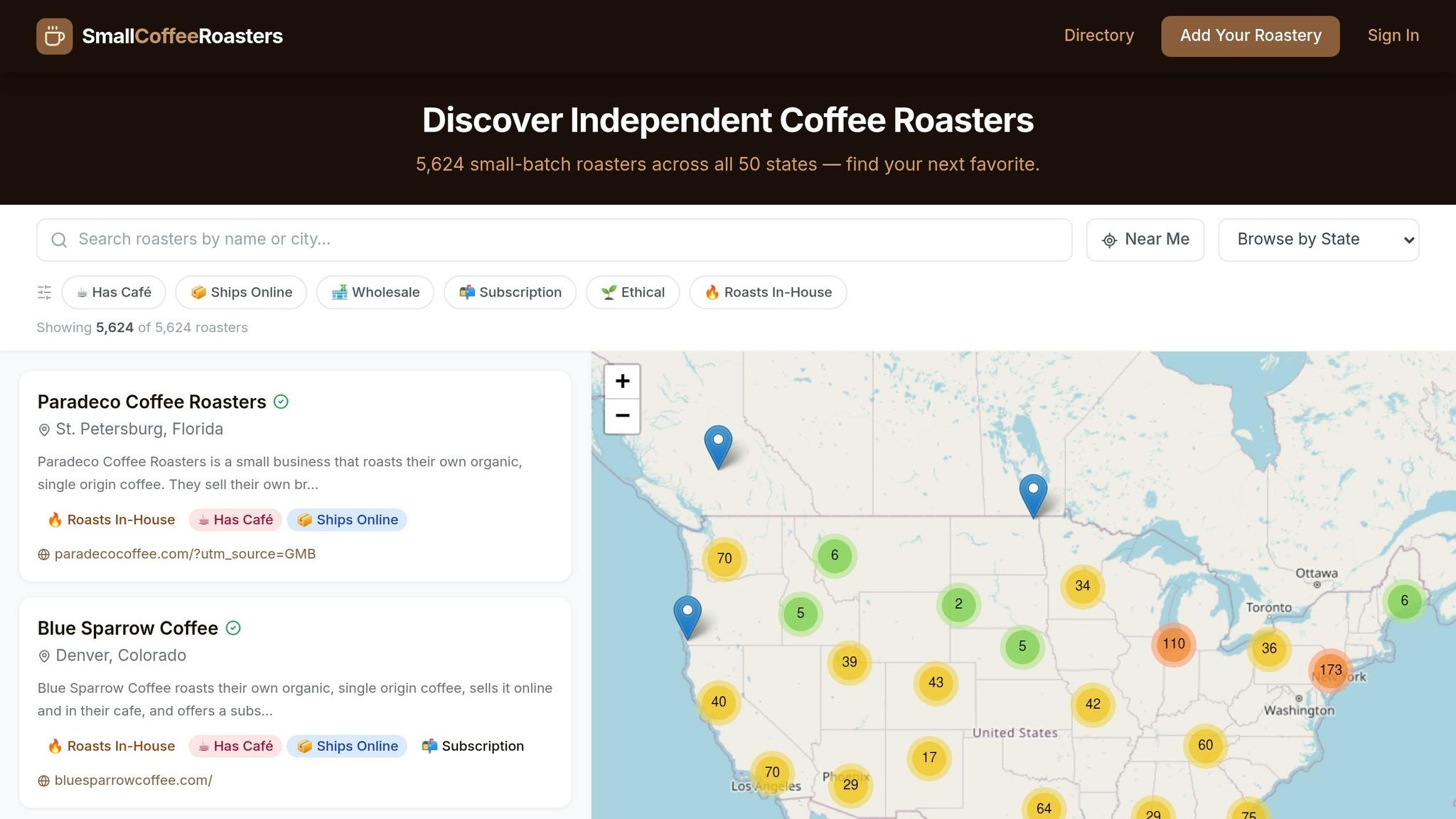
Small Coffee Roasters is a directory of 5,624 independent U.S. roasters you can browse by state or city. Each profile includes details on wholesale availability, product lineup, and shipping coverage.
That makes it easier to screen for roasters that match how you buy. You can filter by shipping coverage, local-delivery thresholds, and order minimums that line up with your volume. Starting with nearby or well-matched roasters can cut shipping time and cost right away.
Review Roaster Websites, Lineups, and Support Details
Once you have an initial list, go through each roaster’s website or wholesale page. Focus on three basic questions: Can they ship to you? Can they cover your menu? Can they handle your ordering process in a way that won’t slow you down?
Check for a mix of year-round blends and rotating single origins. Review the bag sizes they offer, such as 12 oz, 2 lb, 5 lb, and fractional packs. If private-label or contract packaging matters to you, confirm that too.
Then look at how ordering works. Some roasters offer a dedicated wholesale portal with order history and invoice management. Others handle everything by email. Neither setup is wrong, but one may fit your team much better.
If barista training, equipment consulting, or on-site brew recipe development matters for your coffee program, make sure those services are clearly offered, not just hinted at, before you go any further. Once those basics line up, move on to samples and pricing.
Filter by Logistics, Product Fit, and Capacity
Now tighten the list using the numbers you worked out earlier. Many small roasters set MOQs around 20 lbs per order or 25 lbs per month. Many also roast to order and ship within 0–3 business days.
That sounds simple on paper, but timing can get messy fast. Check each roaster’s cut-off days and roast schedule. Some only roast on set days, like Monday, Wednesday, and Friday, with cutoff times that directly affect when your coffee will arrive.
You’ll also want to factor in resting time. Drip coffee often needs 2–4 days after roasting before it tastes its best, while espresso tends to do better with 4–7 days. If your program leans heavily on espresso, that timing has to fit inside your inventory cycle.
Evaluate Coffee Quality, Pricing, and Wholesale Terms
Once your shortlist is tight, the real evaluation starts. This is where you stop relying on roaster websites and start judging what actually matters: what’s in the cup, what’s on the invoice, and what’s in the contract.
Compare Single Origins, Blends, Decaf, Private Label, and Contract Packaging
Look for one partner that can handle your core espresso, brewed coffee, and decaf needs without splitting your supply across multiple vendors. Also make sure they offer decaf for both drip and espresso.
As you review product fit, treat each category like a checkpoint. Blends should work well in milk-based drinks and stay steady during high-volume service. Single origins should show clear origin character for black coffee or featured pour-overs. If you want branded retail bags or a house identity that feels like your own, ask if the roaster offers private label, custom blends, and contract-packaged bags under your brand.
Once the menu mix makes sense, test those coffees on your own equipment.
Request Samples, Cup Samples, and Review Spec Sheets
Don’t commit to a roaster without testing samples in your shop. A coffee that tastes great on a roaster’s setup can act very differently on your espresso machine or batch brewer. Brew samples under normal service conditions and pay attention to aroma, acidity, sweetness, body, and finish. Cup for consistency across multiple samples, not just one batch that happens to shine.
When you review spec sheets, check for origin, sourcing model, processing method, altitude, roast profile, and brew guidance. For specialty-grade coffee, an SCA score of 80 or above is the standard benchmark. Every bag should also include a printed roast date. If that date is missing, ask why before moving forward. For espresso, keep off-gassing in mind: beans roasted fewer than five days ago can taste unbalanced.
After cup quality checks out, move to price, minimums, and delivery timing.
Check Pricing, MOQs, Lead Times, and Contract Terms
Wholesale pricing should come in below retail, and better rates often come with higher volume commitments or fixed-term agreements. As you compare roasters, look at price per pound in U.S. dollars along with MOQs, delivery schedule, and any services included. Training, equipment support, and menu consulting all count toward total value.
Payment terms vary. Common U.S. wholesale terms include COD, Net 15, or Net 30. Read the contract closely too. Exclusivity clauses, equipment leasing terms, maintenance duties, and training schedules can all shape how much room you have to operate.
A good starting point is a 90-day trial period before signing a long-term agreement. That window gives you time to compare multiple shipments, not just the first sample.
| Term | What to Compare |
|---|---|
| Price per lb. | Wholesale rate vs. retail; volume discount tiers |
| MOQ | Per-order minimum vs. monthly minimum |
| Lead time | Days from order to delivery; local delivery vs. UPS/FedEx |
| Freshness | Roast date printed on every bag |
| Payment terms | COD, Net 15, Net 30, or other arrangements |
| Contract clauses | Exclusivity, equipment leasing, exit terms |
Use the best-performing sample and the cleanest terms to narrow your final choice.
Choose a Roaster and Build a Long-Term Partnership
Assess Sourcing Transparency and Day-to-Day Support
Once the samples taste good and the terms seem fair, look at what happens after you place your first order. Cup quality and price matter. But day-to-day communication and support after the sale matter just as much.
Start with sourcing. A transparent roaster should be able to tell you the farm name, varietal, elevation, and processing method for every coffee it sells. If a roaster can't give you that information, cross it off your list.
Then ask about quality control and defects. You want to know how the roaster handles common problems before they happen. Ask what they do if a bag arrives damaged, a shipment shows up late, or a coffee runs out in the middle of the season. A good partner should have a clear process for replacing defective bags and dealing with missed deliveries. If the answers feel vague or defensive, that's a sign to move on. It's also smart to ask for references from current or former wholesale customers.
A lower price per pound doesn't save you money if service is slow or unreliable. The right partner gives you fast replies, clear problem-solving, and steady reorder support.
If the answers sound strong, test them during the trial period.
Run a Pilot Period and Compare Your Top Choices
Test your finalists in your actual café, not just at the cupping table. The trial period is where you see how the relationship works during normal service. Use your own equipment, your full drink menu, and your normal order volume. Track how the coffee performs over several batches, and note whether flavor stays consistent from one shipment to the next.
Get feedback from your staff, and pay attention to how customers react. This is also the time to watch espresso performance, see whether it stays stable, and check how fast the roaster responds when you ask questions or flag supply problems.
When you compare your top options, focus on the metrics that matter most:
| Metric | What to Evaluate |
|---|---|
| Cup quality and menu fit | Specialty grade (80+ SCA score) and flavor fit for your menu |
| Consistency | Uniformity across different roast batches and stable espresso performance |
| Delivery | Lead time accuracy, shipping reliability, and packaging condition on arrival |
| Support | Response time, problem solving, and reorder help |
| Issue resolution | Speed and process for handling defects or missed deliveries |
| Transparency | Farm names, varietals, elevation, processing methods, and direct producer relationships |
Conclusion: How to Make a Confident Wholesale Coffee Decision
The roaster worth committing to is the one that answers your questions clearly, ships fresh coffee on time, steps in when something goes wrong, and can grow with your business as your coffee program changes.
FAQs
How many roasters should I test before choosing one?
Test multiple roasters before you make a call. A good place to start is 2 to 3 roasters, using samples or small trial orders to compare quality, consistency, freshness, and how well each one fits your business.
It also helps to taste the coffee on your actual equipment before placing larger orders. That way, you're choosing a partner based on what you see and taste firsthand.
What if my coffee volume changes seasonally?
If your coffee volume changes with the seasons, tell your wholesale roaster as early as you can. That gives them time to plan with you and helps you keep coffee in stock without ending up with old bags sitting around.
Talk through your expected demand, make sure they can handle shifts in volume, and set up a delivery schedule that has some wiggle room. That way, you’re not scrambling during busy stretches or stuck with too much product when things slow down.
It also helps to ask about lead times and how they manage roasting. Do they roast to order, or do they keep inventory on hand? Those details matter. Clear communication makes it much easier to adjust orders as business changes, while keeping supply steady and coffee fresh.
Should I use one roaster for everything?
It depends on your business needs and priorities.
Working with one reliable wholesale roaster can make life a lot easier. You get consistency, simpler communication, and the chance to build a stronger long-term partnership. It also helps keep flavor profiles uniform and makes ordering more straightforward.
Some businesses work with multiple roasters to offer more variety or cover specific needs. But if simplicity and consistency matter most, one roaster is often the better fit - as long as they meet your standards for quality, delivery, and support.