Future Trends in Coffee Roasting Automation
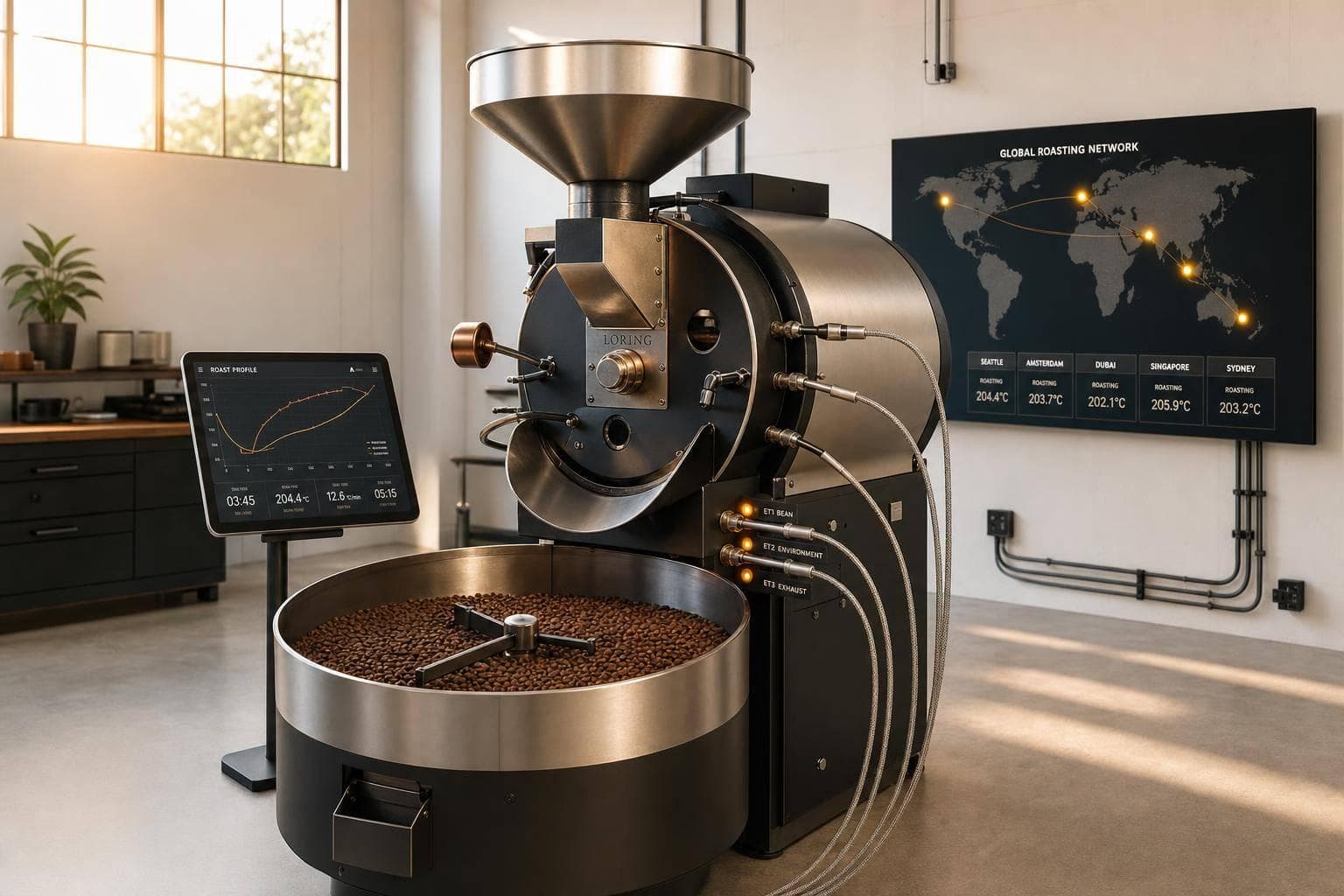
Future Trends in Coffee Roasting Automation
Coffee roasting is moving from manual control to software-led production. In plain terms: more independent coffee roasters are using data, sensors, and AI tools to keep batches consistent, cut defects, lower downtime, and scale production with fewer mistakes.
If I boil the article down, here’s what matters most:
- Labor is tight, and skilled roast staff are hard to find in many U.S. markets.
- Margins are under pressure when green coffee costs around $5–$6 per lb. and wholesale roasted coffee sells for about $12–$14 per lb.
- Consistency matters more as wholesale and subscription volume grows.
- Automation now goes past logging data. New systems can adjust heat, airflow, and drum speed during the roast.
- AI tools can cut training time by up to 50% and reduce roast variation and defects.
- Connected roasteries use dashboards, alerts, batch records, and machine health data to keep teams in sync.
- Multi-site brands can use shared profile libraries to keep coffee closer in flavor across locations.
- Small roasters do not need to automate all at once. A step-by-step path makes more sense: logging first, then profile replay, then live assist tools.
Here’s the simple takeaway: automation is no longer just for big factories. It is becoming part of how independent roasters protect quality and grow without losing control of the cup.
Revolutionizing Coffee Roasting: AI-Powered Roaster & Advanced Heat Transfer by Genio Roasters
sbb-itb-af00fa5
Quick Comparison
| Area | Basic Setup | Mid-Level Setup | Advanced Setup |
|---|---|---|---|
| Roast control | Manual | Profile replay | AI-assisted live control |
| Consistency | Lower | Medium | Higher |
| Training time | Long | Shorter | Can be cut by up to 50% |
| Data use | Post-roast review | Curve matching | Live adjustment + batch learning |
| Oversight | On-site only | Mostly on-site | Remote dashboards and alerts |
| Best fit | Small batch volume | Growing production | Wholesale, private label, multi-site |
If I had to sum up the whole piece in one line, it would be this: the future of roasting automation is layered, data-driven, and still guided by the roaster - not replaced by the machine.
AI and Machine Learning in Roast Control
Roasting software has changed a lot. It doesn’t just log data anymore. It learns from past batches and uses that data to guide the roast as it happens.
That matters because the goal isn’t just to repeat a curve on screen. It’s to get closer to the same cup result, batch after batch. AI-driven platforms do that by using each roast to fine-tune the next one.
AI-Assisted Adjustments During the Roast
The biggest shift happens during the roast itself, not after it ends. Systems like the Hermetheus Co-Pilot™ and Besca's Gen II series track bean temperature, airflow, and drum speed at high frequency - dozens of readings per second - and compare that live data against a reference profile.
When the roast curve starts to drift, the system can step in with small changes to heat and airflow before the batch slips off target. Think of it like a co-pilot watching the road a few seconds ahead instead of reacting after the car starts to skid.
One of the hardest moments in a roast is the heat spike around first crack. If the roaster doesn’t cut back energy at the right time, the batch can hit what’s called a "crash and flick" - a pattern that can lead to baking or scorching. AI helps by seeing that spike coming and reducing burner output ahead of time. The roaster still has the final say and can override the system.
That live control gets even more useful when the software also learns which changes lead to the best flavor in the cup.
Machine Learning for Profile Matching and Flavor Consistency
Profile replay sounds good in theory, but it breaks down when the beans or the room change. Machine learning deals with that by looking at more than the recorded settings. It factors in bean density, moisture content, origin, processing method, screen size, and bean age to predict how coffee will react to heat. It also accounts for ambient humidity, altitude, and air temperature.
The feedback loop is where this starts to pay off. When cupping scores, Agtron color readings, and batch data are fed back into the system after each roast, the software gets better at predicting which changes will lead to the flavor result the roaster wants. Over time, that builds a profile library that gets sharper with each batch.
One clear result: AI-powered roast management can cut training time for new production staff by as much as 50%. Instead of spending months building tactile intuition from scratch, new operators can work from software-guided parameters while the system handles the fine control.
Here’s the trade-off at a glance:
| Feature | Manual Roasting | Profile Replay | AI-Assisted Control |
|---|---|---|---|
| Consistency | Low; depends on operator focus | Moderate; repeats settings but ignores environment | High; adjusts in real time for bean and ambient shifts |
| Flexibility | High; roaster can pivot instantly | Low; follows a rigid recorded path | High; suggests adjustments while allowing override |
| Setup Cost | Low | Moderate | High |
| Training Time | Years | Months | Weeks |
| Defect Risk | High | Moderate | Low |
New Sensors and Data Inputs
Better predictions depend on better inputs. Standard bean temperature probes are still part of the setup, but newer systems add image-based color analysis too. That means live cameras can track bean surface color and size distribution while acoustic sensors listen for the sound of first crack. The Roest P3000, for example, combines both in one platform.
Some newer systems are also testing chemistry-based sensors that measure roast development with more than color alone. On top of that, sensors that track ambient humidity, altitude, and temperature help roasters adjust for the small day-to-day changes that can throw off a batch.
Those extra inputs are what make remote dashboards and multi-site oversight work in practice.
Remote Roast Management and Connected Roasteries
Those sensors also feed connected roastery software, which pushes quality control past the machine itself. It starts with live roast data and batch tracking, then gives the team a clear view of what’s happening across the roastery.
Cloud Dashboards, Alerts, and Batch Tracking
Modern roasting platforms log data at one-second intervals - bean temperature, rate of rise (RoR), airflow, gas pressure, and drum speed - and send it to a central dashboard that staff can view remotely. During a live roast, roasters can place a reference curve over the batch in real time, so any drift from the target profile shows up right away.
These platforms also keep a searchable record of:
- Roast profiles
- Green coffee inventory
- Weight loss percentages
- Cupping data
Alerts add another layer of control. If a roast curve moves outside the accepted range, the system flags it and notifies a quality manager at once. IoT sensors can also point out service needs before a machine fails. In some setups, connected systems can cut equipment downtime by up to 50%.
There’s one key limit here: roast control stays local, not in the cloud. That’s by design. If the internet drops in the middle of a roast, the machine keeps running safely. Cloud links are used mainly for data storage, remote support, and profile syncing - not for live burner control.
Sample Roasting and Production Translation
One of the most useful shifts in connected roasteries is the way sample roasting feeds straight into production. A roaster can build a profile on a small sample roaster like the Ikawa Pro V3 and then scale that curve to a 30 kg commercial machine.
That means fewer trial batches and a smoother move from sample review to full production. It also makes life easier for teams trying to keep output steady across more than one site.
Multi-Site Consistency and Oversight
For roasters working across multiple locations, cloud-connected systems change day-to-day oversight in a big way. A head roaster can send an approved profile from one central platform to machines at different sites, helping the business keep the same flavor result from place to place.
Cropster users report a drop in roast-to-roast variation of 30% to 40% with this kind of centralized profile management.
There’s also a simple but important knowledge-retention upside. If a head roaster leaves, the company’s signature profiles and full roast history don’t walk out the door. They stay in the system, ready for the next roaster to use.
Connected roasteries can tighten consistency and help with maintenance, but they still rely on local machine control and hands-on troubleshooting. That matters even more in wholesale and private label production.
How Automation Changes Wholesale and Private Label Roasting
Wholesale and private label roasting run on fixed schedules and tight specs. Once volume climbs, automation stops being a nice extra and starts looking like a production must-have. That matters even more when several accounts expect the same flavor profile every single week.
Why High-Volume Programs Depend on Repeatable Profiles
In roasting, small slips add up. As operators get tired, drift tends to creep in, and over a long production day those minor differences can stack on top of each other. For private label clients, that kind of variation isn't just annoying. It can turn into a contract problem fast.
AI-driven platforms can reduce batch-to-batch inconsistency by up to 40%. AI-optimized roasting has also been shown to cut defect rates by 30% while improving total yield by 12%. For a high-volume program, those numbers matter because they touch the two things buyers care about most: cup consistency and output.
Digital Profile Libraries and Production Efficiency
Digital profile libraries give each client a saved set of roasting settings, QC limits, and production notes. So instead of leaning on memory or handwritten notes, operators can run approved coffees through a set process. That makes account changeovers smoother and gives QC teams a clear audit trail when something drifts.
Automated logs also make training less painful. New operators can follow software-guided profiles instead of trying to learn everything by instinct on day one. Onboarding time can drop by as much as 50%, and variance reviews move faster for QC teams because the production record is already there.
Finding U.S. Roasters With the Right Capabilities
In the day-to-day work, the difference usually shows up in labor, consistency, and how well a roaster handles client-specific needs.
| Feature | Lower-Automation Setup | Higher-Automation Setup |
|---|---|---|
| Labor Hours | High; requires constant manual monitoring of every batch | Low; one operator can oversee multiple machines |
| Consistency | Variable; dependent on operator feel and manual notes | Higher consistency with IoT sensors and AI-driven adjustments |
| Training Time | Long; years required to learn roasting by smell and sound | Up to 50% faster onboarding via software-guided profiles |
| Custom Profile Flexibility | Limited by the operator's ability to replicate complex curves manually | High; digital libraries store and execute custom client profiles |
For wholesale and private label sourcing, automation level is one of the fastest ways to gauge whether a roaster can take on contract work. Small Coffee Roasters lists U.S. roasters with in-house roasting, wholesale availability, online shipping, and subscriptions, which makes it a solid starting point for sourcing.
What Small and Independent Roasters Should Do Next
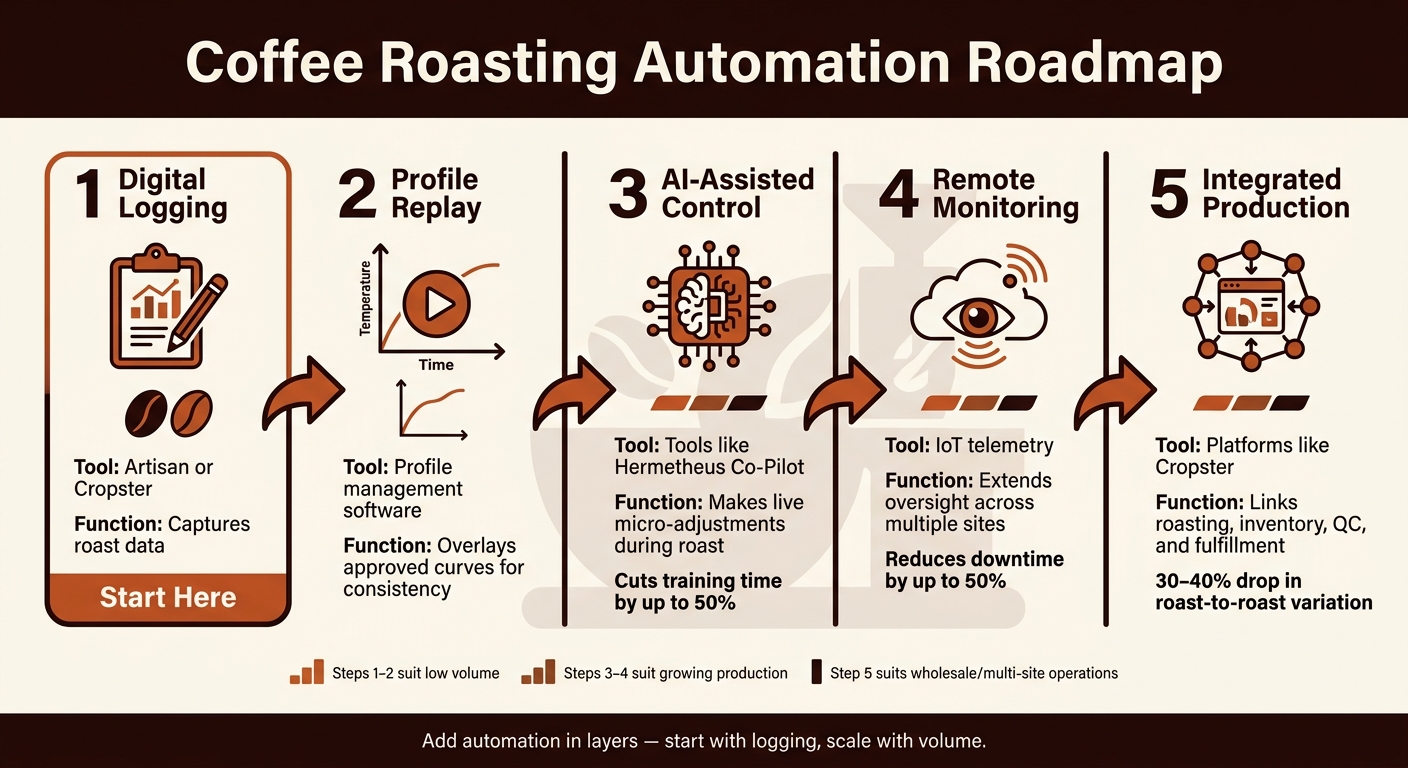
Coffee Roasting Automation Roadmap: 5 Steps for Independent Roasters
A Step-by-Step Automation Roadmap
Independent roasters don't need to rip out their whole setup to start using automation. The smarter move is to begin with software, then bring in hardware later as production climbs.
Once you know the main tools, the next step is figuring out what to put in place first.
| Step | Tool/Approach | Function |
|---|---|---|
| 1. Digital Logging | Artisan or Cropster | Captures roast data |
| 2. Profile Replay | Profile management software | Overlays approved curves |
| 3. AI-Assisted Control | Tools like Hermetheus Co-Pilot | Makes live micro-adjustments |
| 4. Remote Monitoring | IoT telemetry | Extends oversight across sites |
| 5. Integrated Production | Platforms like Cropster | Links roasting, inventory, QC, and fulfillment |
At low volume, manual logging can still do the job. But as batch counts go up, it starts eating time and making consistency harder to hold. Remote monitoring and integrated production tend to matter more when one team can't keep eyes on every roast by hand anymore.
How Roaster Roles Will Change
As automation handles more of the execution, the roaster's job doesn't vanish. It changes shape.
Instead of spending as much time on repeat manual adjustments, roasters can put more attention on cupping, sourcing, and reviewing data. Teams can also use telemetry to catch equipment problems early and cut downtime. The flavor targets and brand identity still come from the roaster. Automation helps carry those choices through each batch, turning sensory notes into production targets that the system can follow.
Key Takeaways
The main point is simple: add automation in layers, not all at once.
Automation now helps lock in consistency, but the roaster still sets the profile. AI-assisted tools are improving at profile matching, live adjustments, and remote oversight. That's a big deal for wholesale programs that rely on repeatability. For independent roasters, the path is gradual: start with logging, move into profile replay, and bring in AI tools when volume makes the case, while keeping brand character in place and improving repeatability.
FAQs
How much does roast automation cost?
Roast automation costs can land all over the map. At the lower end, compact connected sample roasters start at about $3,500. Move up to shop-level automated systems, and pricing can reach around $22,000.
Once you get into industrial-grade equipment, the upfront spend jumps fast. Some businesses also set aside $15,000 to $20,000 for added electrical infrastructure. And for teams that want steadier monthly planning, subscription-based models can make costs more predictable.
Can small roasters automate without losing roast quality?
Yes. Modern automation is built to support the roaster’s skill, not replace it. It controls variables like temperature, airflow, and drum speed with steady precision.
That takes repetitive manual work off the roaster’s plate. So instead of babysitting every adjustment, they can spend more time on data analysis, quality control, and profile development - while keeping roast quality consistent as the business grows.
What should a roastery automate first?
Start with centralized data logging and roasting software. Swapping out paper records cuts down on mistakes and makes it much easier to repeat profiles, manage inventory, and keep quality steady from batch to batch.
When your software connects to your machine, you also get real-time data. That means you can track temperature and rate of rise with more control and consistency before you move into more advanced AI-assisted automation.