Top 5 Automated Coffee Roasting Systems
Top 5 Automated Coffee Roasting Systems
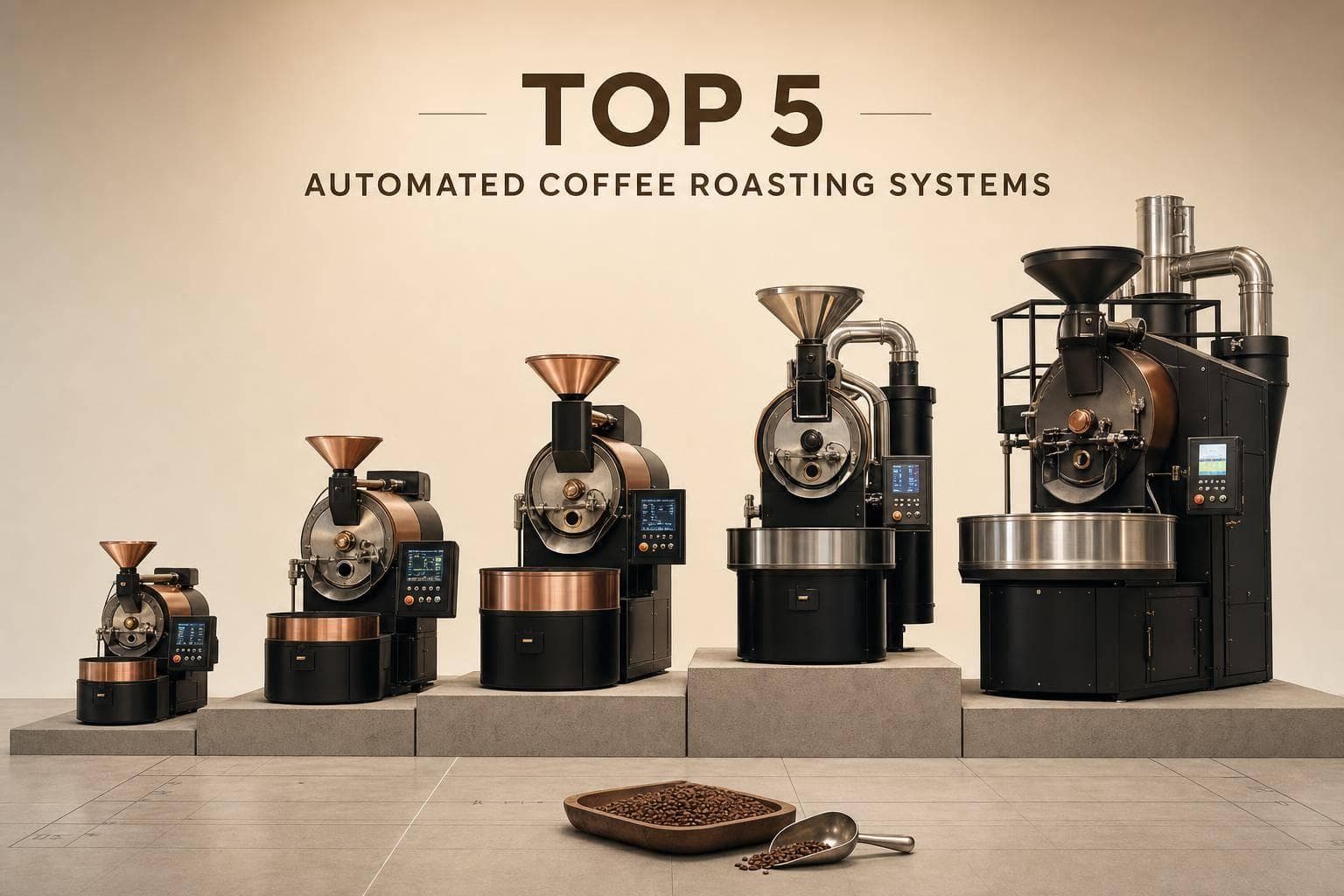
If I had to sum this up fast: pick by batch size, install limits, and how much control you want. For sample work, I’d look at Roest L100 or Ikawa Pro100. For independent coffee roasters doing in-store roasting, Bellwether and Stronghold S7 Pro fit best. For steady output, Loring Falcon S15 is the clear production pick.
Here’s the short version:
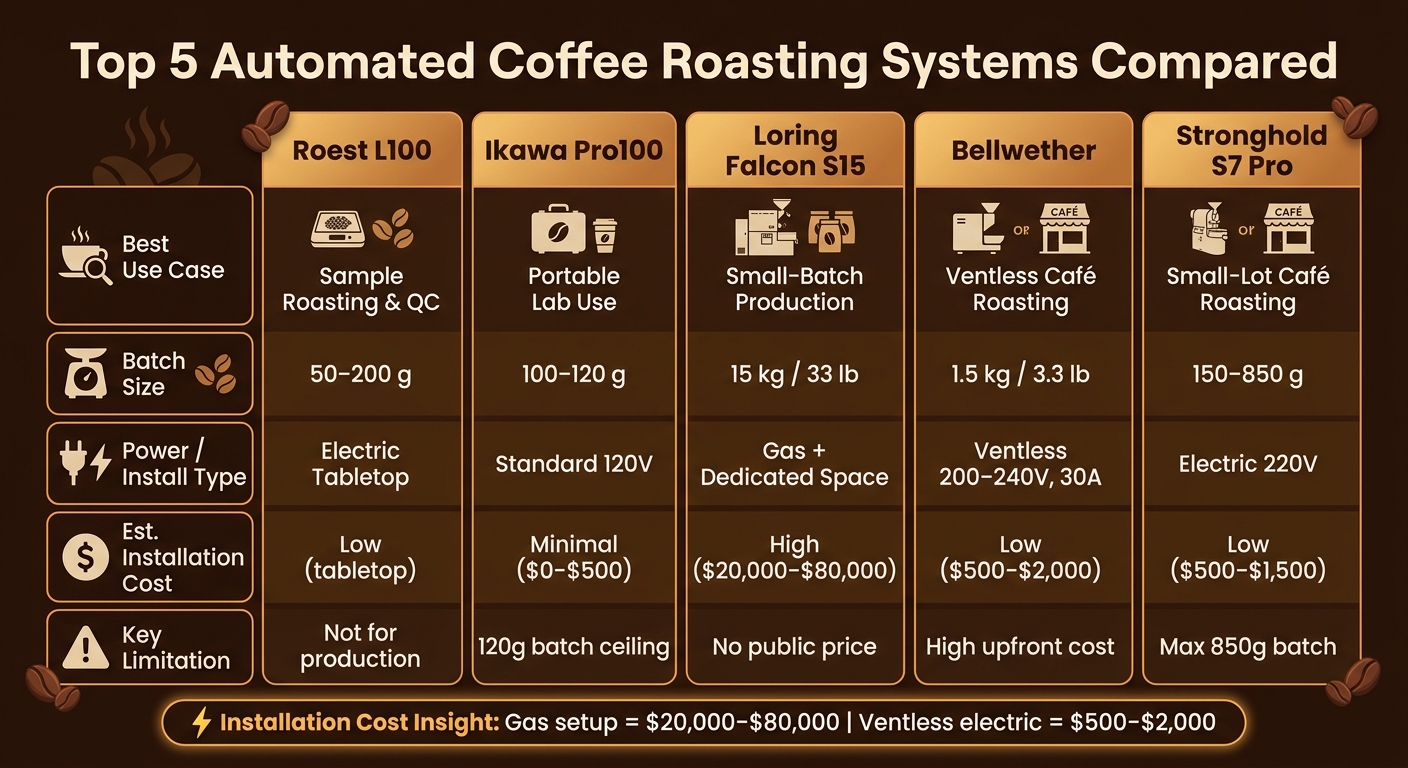
- Roest L100: best for sample roasting and QC, with 50–200 g batches
- Ikawa Pro100: best for portable sample roasting, with 100–120 g batches on 120V
- Loring Falcon S15: best for production, with 15 kg / 33 lb batches
- Bellwether: best for ventless café roasting, with 1.5 kg / 3.3 lb batches
- Stronghold S7 Pro: best for small-lot café roasting, with 150–850 g batches
A big cost point is installation. A ventless electric setup may need only $500–$2,000 in electrical work, while a gas setup can run $20,000–$80,000. That one line alone can rule machines in or out.
Top 5 Automated Coffee Roasting Systems Compared
Inside the Worlds Most Advanced Sample Coffee Roaster (Roest L200 Ultra Review)
sbb-itb-af00fa5
Quick Comparison
| System | Best Use | Batch Size | Power / Install | Main Limitation |
|---|---|---|---|---|
| Roest L100 | Sample roasting, QC | 50–200 g | Electric tabletop | Not built for production |
| Ikawa Pro100 | Portable lab use | 100–120 g | 120V; may need venting for heavier use | Very small batch cap |
| Loring Falcon S15 | Small-batch production | 15 kg / 33 lb | Dedicated roast space; gas-based setup | No public price |
| Bellwether | Front-of-house café roasting | 1.5 kg / 3.3 lb | Ventless; 200–240V, 30A | Higher upfront cost |
| Stronghold S7 Pro | Small-lot roasting | 150–850 g | 220V electric | Lower output than production roasters |
My takeaway: if you roast for cupping, buy for data and repeat runs. If you roast in a café, buy for install ease and footprint. If you roast for sales volume, buy for throughput first.
Below, I break down where each system fits, what it does well, and where it may fall short.
1. Roest L100
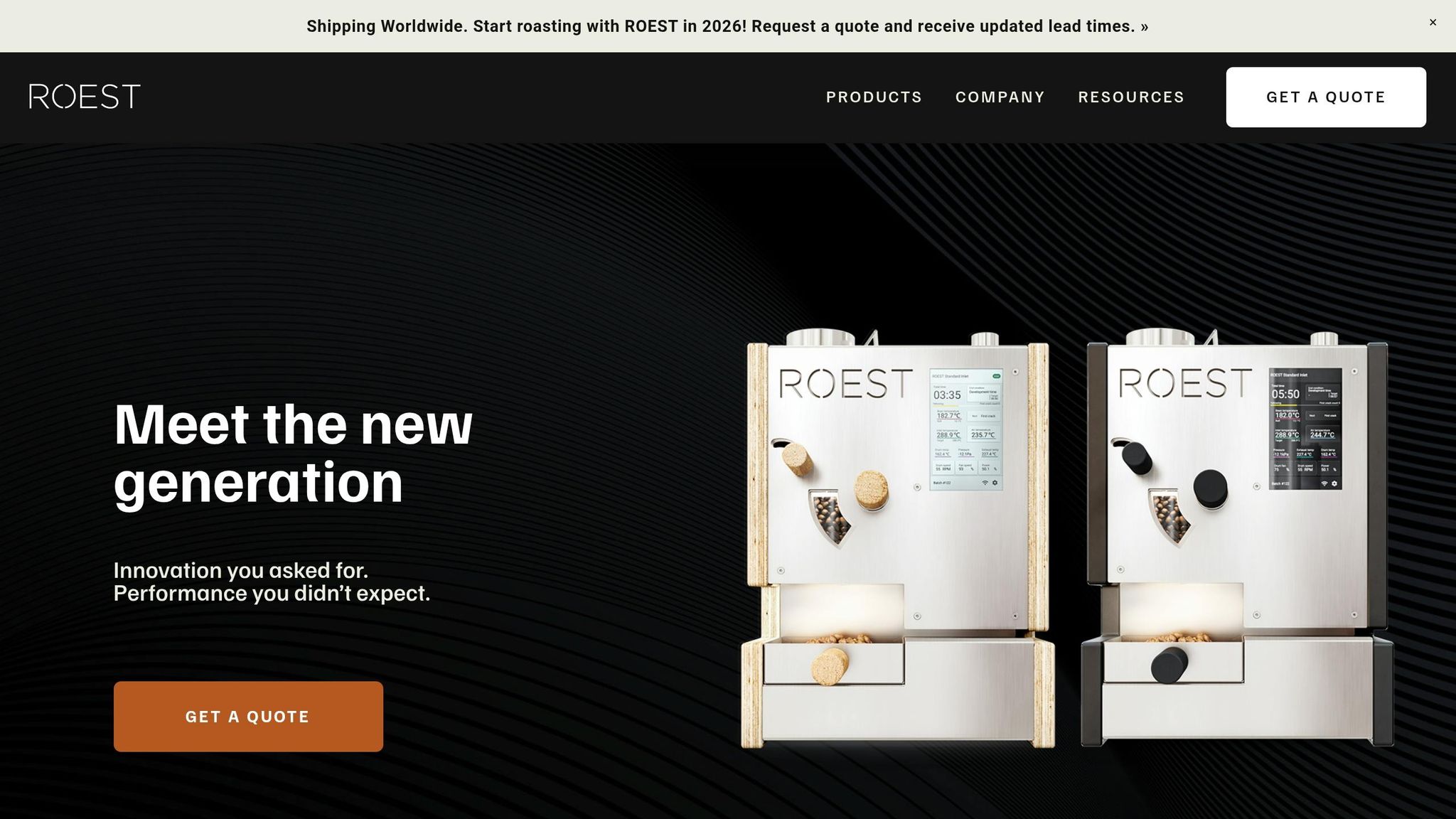
The Roest L100 is a tabletop sample roaster built for QC and profile work, with a batch range of 50 to 200 grams. It’s made for sample roasting and profile development, not for production runs. That focus puts it in the benchmark category for small-scale, data-led automated roasting.
Batch Capacity
The L100 comes in two versions: Plus and Ultra. Both use the same 50 to 200 gram batch range.
The difference is throughput. The Plus handles 10+ batches per hour, while the Ultra can reach 15+ batches per hour with Counterflow mode, which reverses drum rotation to improve heat transfer. For teams running a lot of samples in a day, that extra speed can make a big difference.
Automation & Data Control
The automation here is built for repeatable sample testing, not push-button production.
The L100 Plus includes five temperature sensors:
- bean
- air
- inlet
- exhaust
- drum
The Ultra adds a drum pressure sensor.
Both models include First Crack Detection, which helps keep roasts more consistent by automating event logging, development time tracking, and bean drop. Roast data moves through ROEST Connect, the company’s software platform for inventory, roast profiles, data review, and cupping sessions.
The Between Batch Protocol (BBP) resets the machine’s thermal energy between runs, so each sample starts from the same baseline conditions. If you care about clean comparisons from one roast to the next, that matters a lot.
Installation Requirements
The L100 is a fully electric tabletop unit aimed at labs and cafés. Because it’s electric and compact, setup is simpler than with many gas-based machines.
It also uses a dual-fan setup that separates roasting exhaust from cooling, which helps support back-to-back roasting.
Cost & Scalability
The L100 is a specialist tool, not a production roaster. Profiles built on the L100 can help guide work on larger systems, but direct transfer still needs manual adjustment.
So the right way to judge it is pretty simple: it’s strongest as a sample roasting and QC tool, not as a machine for day-to-day production.
2. Ikawa Pro100
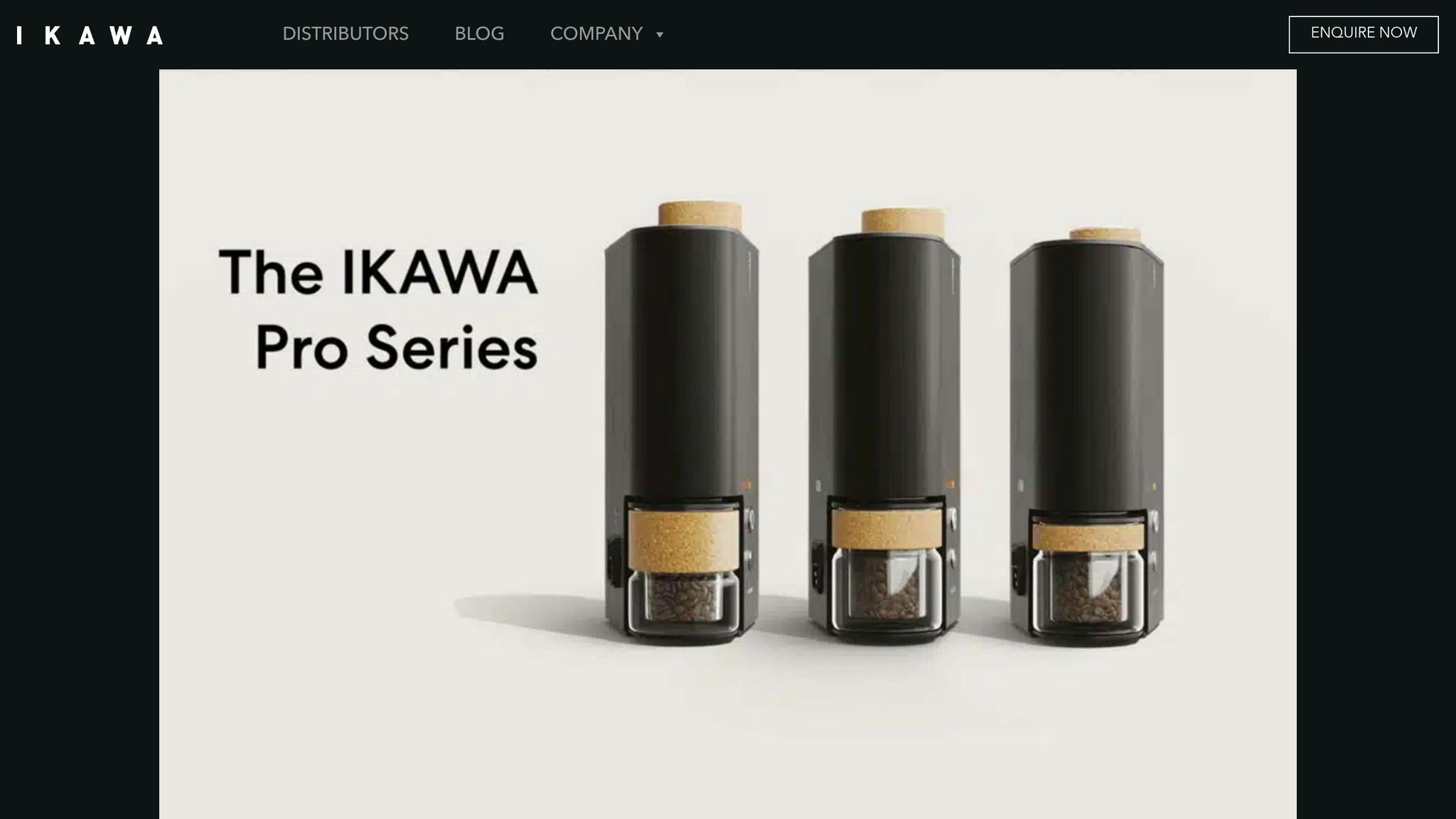
Compared with drum-based sample roasters, the Pro100 takes a different path. It uses convection and app-based profiles to make sample roasting cleaner and faster. The Ikawa Pro100 is a compact convection sample roaster built for QC labs and quick profile repeat runs. Its 100% convection system keeps beans suspended in hot air instead of tumbling them in a drum, which helps cut down on contact scorching.
Batch Capacity
The Pro100 has a recommended batch size of 100g and a maximum capacity of 120g (about 4.23 oz). That 120g ceiling gives you enough coffee for cupping, purge, and routine lab checks.
It can move through sample roasting at about 800g per hour, or roughly 6–8 batches. The Pro 100X pushes that to about 1.0 kg per hour, making it the only Ikawa model that clears that mark.
Automation & Data Control
The workflow is simple: pick a profile, load the beans, and let the machine handle heat and airflow on its own. The roaster connects through a free iOS/Android app over Bluetooth, and the app includes a Graph Editor for custom profiles, plus profile sharing across locations.
On the standard Pro100, you mark first crack manually in the app. The Pro 100X handles that step on its own with AI-driven detection that uses humidity sensors. For labs roasting a lot of samples and trying to keep results tight from lot to lot, that can save time and reduce operator variation.
Installation Requirements
In the U.S., the Pro100 runs on a standard 120V outlet, and its small footprint makes it easy to place on a lab bench or countertop. If you're roasting light volumes, working near a window may be enough. But if you plan to roast often or run darker profiles, you'll need external venting.
Cost & Scalability
The Pro100 lists at about $5,050, while the Pro 100X comes in at about $6,950. Both prices exclude VAT and were converted from GBP using 2026 rates.
If you need to move past 120g batches, scaling usually means adding more units instead of moving up to a bigger machine in the same line. For QC labs running SCA-standard cuppings and wanting portable, plug-and-play consistency, the Pro100 fits the job well.
3. Loring Falcon S15
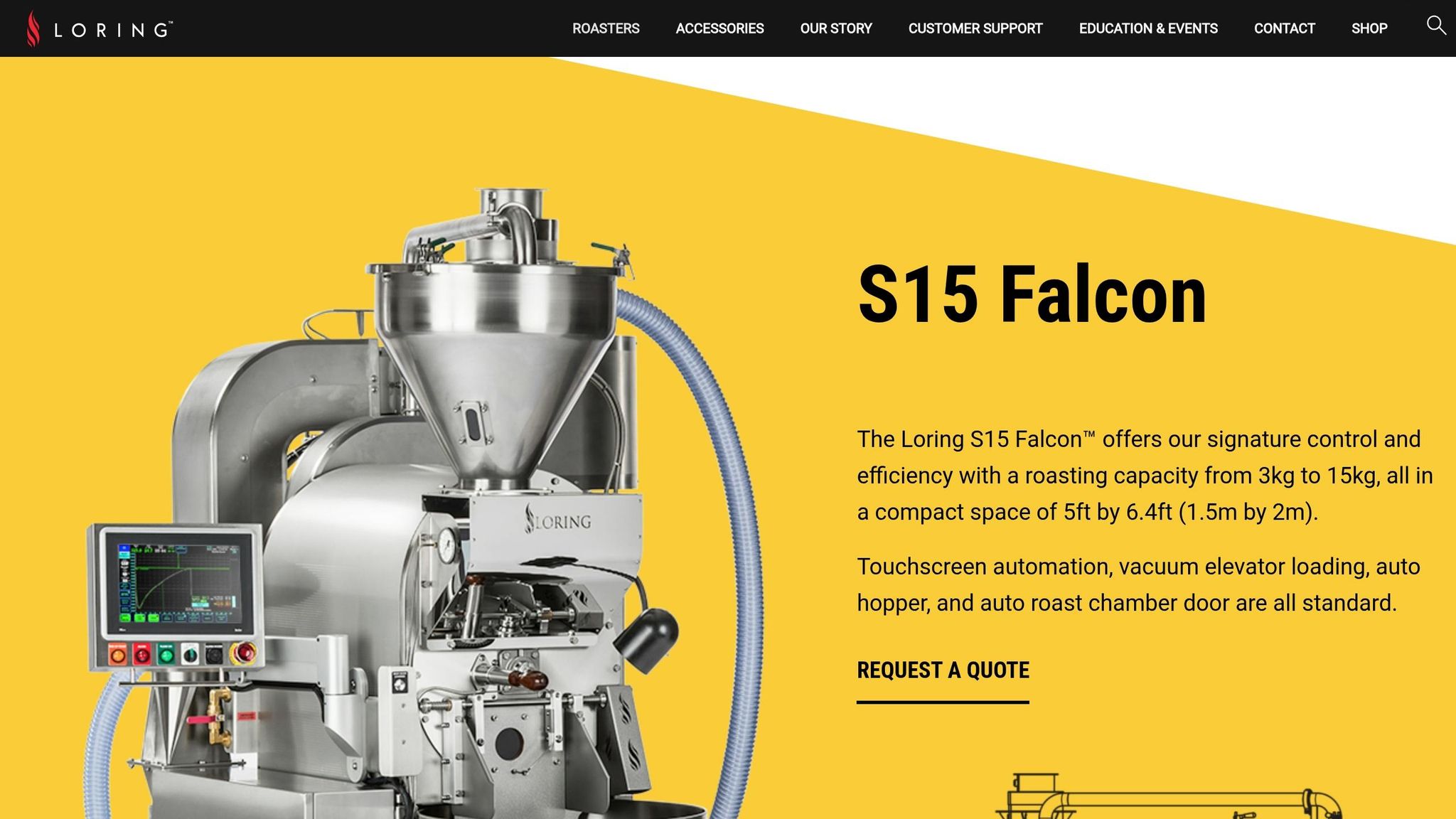
The comparison now shifts from sample roasters to a production system built for steady, repeatable daily output.
The Loring Falcon S15 is a 15 kg (33 lb) production roaster made for small-batch roasting with a production focus.
Batch Capacity
With a 15 kg batch size, the S15 is aimed at roasters that need repeatable output, not sample-level testing. It also comes with a high-speed cooling tray, which helps protect bean quality between batches.
Automation & Data Control
The S15 runs as an automatic, profile-driven system. In plain English, that means the machine can execute saved roast profiles with very little operator input. It’s built for consistent production runs, not for hands-on profile creation.
A touch-screen interface manages profile selection and execution, so operators can spend less time adjusting heat and airflow by hand and more time paying attention to coffee development.
Once a profile is dialed in, the S15 can repeat it across batch after batch with a high level of consistency.
Installation Requirements
One of the S15’s biggest selling points is its integrated smoke incineration. A single burner handles both roasting and smoke incineration, so there’s no need for a separate external afterburner.
That setup can lower infrastructure costs by avoiding the $10,000–$30,000 expense often tied to external afterburners in more common roasting setups. The machine also includes a self-cleaning hot stack and tool-less access, which makes maintenance easier. Even so, buyers still need a dedicated roasting space.
Cost & Scalability
This is the first machine in the list built for sustained production instead of lab or sample work. Loring does not list a public MSRP, so most buyers need to request a direct quote.
For roasters planning to grow, Loring offers a straightforward path within the same product line:
- S7 Nighthawk (7 kg)
- S15 Falcon (15 kg)
- S35 Kestrel (35 kg)
- S70 Peregrine (70 kg)
These machines use similar automated technology. And because they’re made in the U.S.A., parts sourcing and service support may be easier for buyers in the United States.
That makes the S15 a stronger match for production roasting than for sample roasting or front-of-house use.
4. Bellwether Coffee Roaster
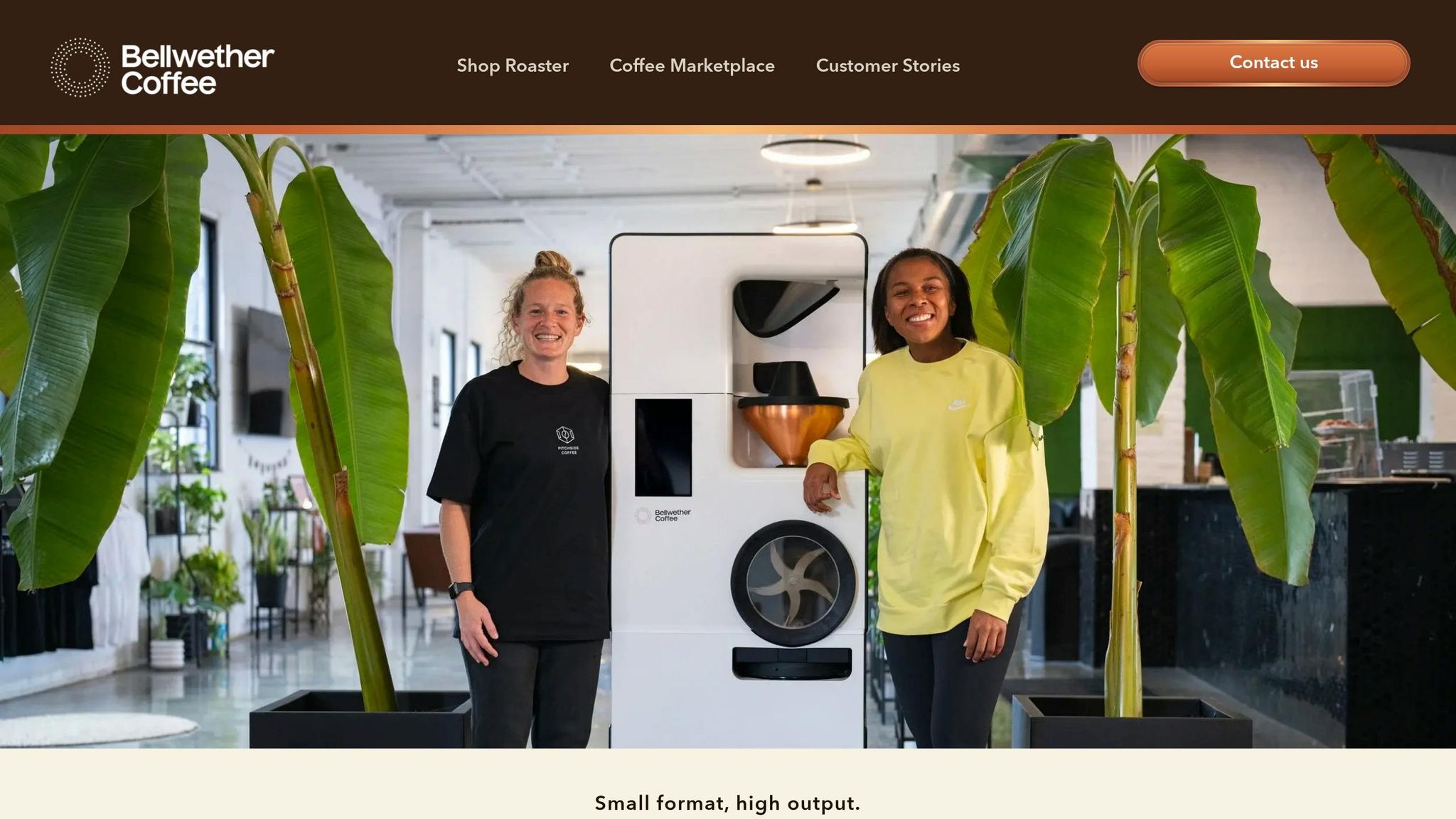
Bellwether takes this list in a different direction. Instead of a larger production roaster, it focuses on ventless, in-store roasting for cafés and smaller coffee brands. The pitch is simple: roast on site without gas lines, venting, or a dedicated roast expert.
Batch Capacity
The Bellwether Shop Roaster handles 1.5 kg (3.3 lb) per batch and runs 3–4 batches per hour, which works out to about 4.5–6 kg (10–13 lb) per hour. Over an 8-hour day, that comes to roughly 36–48 kg (80–105 lb).
Automation & Data Control
The workflow is straightforward. You load the green coffee, pick a profile, and press start. From there, the machine controls heat, airflow, timing, and cooling, which cuts active labor down to about 2 minutes per batch.
Bellwether also includes a cloud-connected platform with hundreds of pre-built roast profiles made by professional roasters. If you want more control, you can build custom profiles and sync them across more than one location.
Its green coffee marketplace also comes with ready-to-roast profiles, which makes the setup even simpler for shops that want to move fast.
Installation Requirements
This is an all-electric, fully ventless system. Bellwether uses an internal catalytic afterburner and filtration to cut smoke and VOCs, so you don't need external ductwork, a roof penetration, or a separate afterburner.
Power requirements are pretty specific: a dedicated 200–240V, 30A single-phase circuit with a NEMA L6-30P plug. Electrical installation usually costs $500–$2,000. The machine is certified for indoor commercial use, including UL 197, UL 710, and NSF4.
Cost & Scalability
The Shop Roaster usually sells for $25,000 to $35,000. Bellwether estimates operating costs at about $0.02/lb for electricity and $0.35/lb for labor and maintenance. Annual maintenance is estimated at $200–$500.
If you need more output, Bellwether offers a continuous-roasting upgrade with a 20 kg (44 lb) autoloader. It can run 13 consecutive batches and push daily throughput past 80 kg.
"The continuous roasting is a game changer. We can literally just load it, and it just goes." - TIABI Coffee and Waffle
5. Stronghold S7 Pro
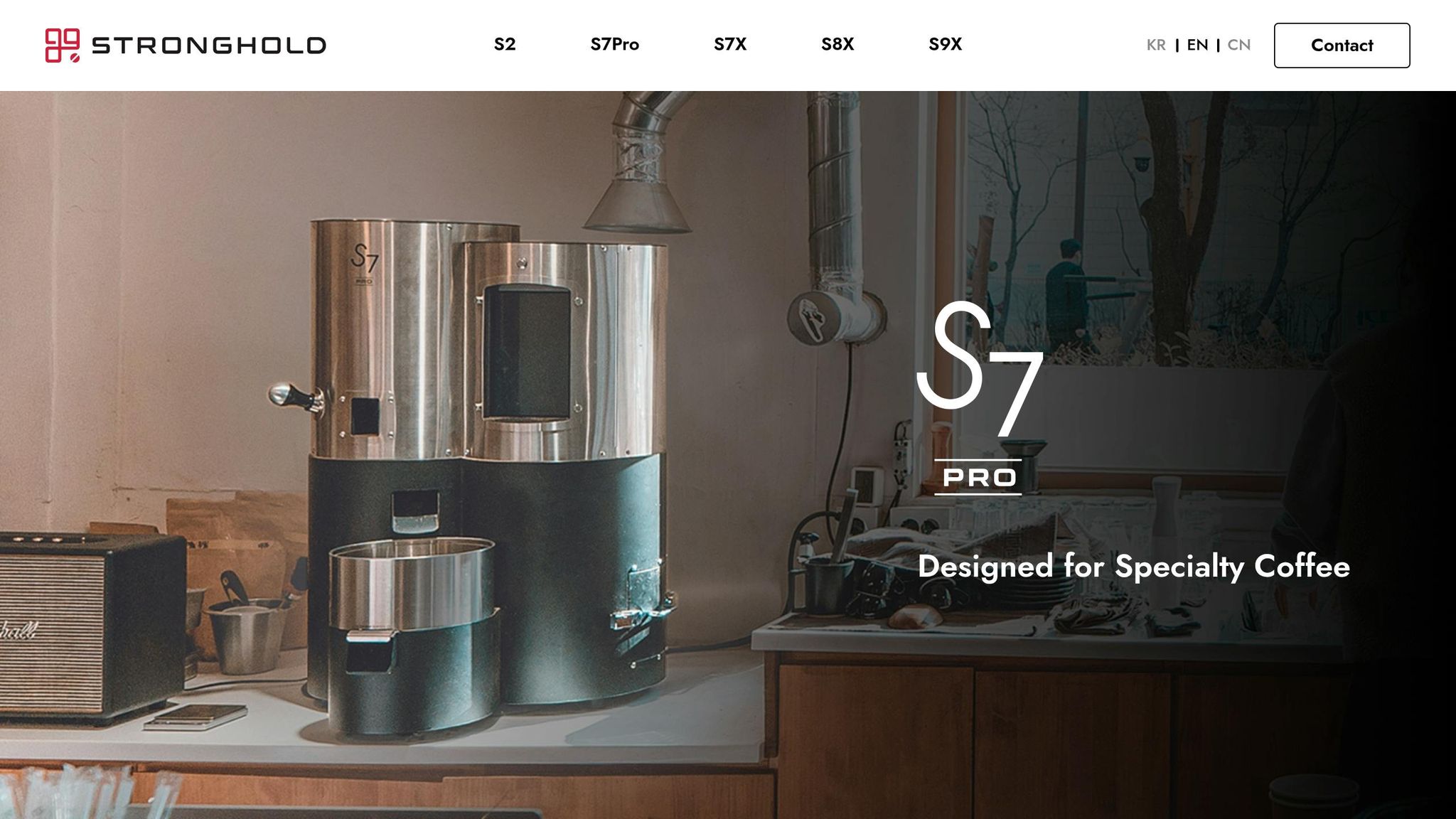
The Stronghold S7 Pro sits in that middle ground between a sample roaster and a full production machine. It's a compact automated roaster built for steady, low-volume output. With a batch range of 150g to 850g, it works well for profiling, QC, and small-lot roasting.
Batch Capacity
The S7 Pro roasts 0.33 lbs to 1.87 lbs (150g–850g) per batch. That puts it beyond pure sample roasting, but still below production-scale output.
Its main strength is repeatable small-lot roasting. If profile consistency matters more to you than sheer volume, this is where the machine starts to make sense.
Automation & Data Control
The S7 Pro runs on Stronghold's Roastware platform. Roastware supports profile auto-saving and auto-replication, so you can repeat the same roast with less manual correction. Its algorithm also adjusts heat automatically to help reproduce profiles when ambient conditions shift.
The machine uses a patented triple heat system that combines convective, radiant, and conductive heat inside a tower drum design. Roastware also includes Program Roasting, which uses origin and process data. If you want to build or tweak profiles by hand, manual control is still there. A 10.1-inch touchscreen gives you real-time monitoring and control.
It does not include the X-Lens infrared bean sensor or the drum heater found on the S7X.
Installation Requirements
The S7 Pro is all-electric, so installation is fairly simple. It needs only a 220V outlet and uses 3.5 kW of power.
Its footprint is about 26.8 x 24.6 x 34.8 inches, and it weighs about 158 lbs. For indoor or front-of-house setups, Stronghold also offers smoke filters like the J7 and JT.
Cost & Scalability
The Stronghold S7 Pro costs about $16,600 USD (€15,500). If your roasting volume grows past its 850g limit, Stronghold offers larger models that use the same Roastware interface:
- S8X: 3.3–9.9 lbs (1.5–4.5 kg) per batch
- S9X: 6.6–17.6 lbs (3–8 kg) per batch
That makes the S7 Pro a solid match for cafés and micro-roasteries that want automation without stepping into full production volume. It fits best in small-lot roasting where repeatability matters more than output.
Best Use Cases for Each System
Not every roaster makes sense for every business. The right pick comes down to the job: sample roasting, café service, or wholesale output.
A simple way to look at it is by role:
- sample work
- customer-facing roasting
- production output
Sample Roasting and QC
For green buying and cupping, Roest L100 is the best fit. If you need fast, portable sample runs, Ikawa Pro100 is a better match.
The Roest L100 stands out for repeatable QC and cupping workflows. Its automation, sensor setup, and ROEST Connect platform make it a strong choice when consistency matters from batch to batch.
The Ikawa Pro100 works well for labs that want plug-and-play sample roasting on a standard 120V outlet. It’s a simple option when speed and portability matter more than a deeper QC setup.
If the machine needs to live on the counter, the best fit changes. In that case, Bellwether or Stronghold makes more sense.
Café and Front-of-House Roasting
Bellwether is the clearest fit for cafés that want visible, on-site roasting without gas or venting. It’s built for front-of-house use, so it works well when roasting is part of the customer experience.
Stronghold S7 Pro also fits café counters, especially when a smaller roaster with tighter control is the better choice.
If you need more daily volume, step up to the Loring Falcon S15.
Production-Focused Small-Batch Roasting
For wholesale output, Loring Falcon S15 is the best fit. It’s the strongest option here for production-focused small-batch roasting.
Bellwether can scale well for in-store volume, while larger Stronghold models can push farther into production.
Pros and Cons of Each System
The big tradeoffs here come down to batch size, installation, and how much of the roasting process each machine handles for the operator.
Here’s a quick side-by-side view:
| System | Key Pros | Key Cons | Best For |
|---|---|---|---|
| Roest L100 | Hybrid heat system, strong QC repeatability, deep sensor data | High purchase price; needs exhaust planning at higher throughput | Sample roasting and QC |
| Ikawa Pro100 | Plug-and-play setup, standard 120V power, fast sample cycles | 120g batch ceiling; scaling requires multiple units | Portable lab and QC use |
| Loring Falcon S15 | Integrated smoke incineration, profile-driven production, U.S.-made | No public MSRP; requires dedicated roasting space | Production-focused small-batch roasting |
| Bellwether Coffee Roaster | Ventless design, front-of-house ready, simplified installation | High purchase price; needs a dedicated 240V circuit | Ventless café and retail spaces |
| Stronghold S7 Pro | All-electric, compact footprint, strong profile repeatability | Limited to 850g batches; lacks advanced sensors of higher-tier models | Café counters and small-lot roasting |
This snapshot makes the fit a lot clearer.
If your main job is sample work and QC, the Roest L100 and Ikawa Pro100 stand out. The Roest leans more toward deep control and data, while the Ikawa keeps things simple and mobile.
If you want a machine that works well in café service or customer-facing retail, the Bellwether Coffee Roaster and Stronghold S7 Pro make more sense. They take up less space and are easier to fit into a front-of-house setup.
If you're aiming for small-batch production, the Loring Falcon S15 sits in a different lane. It’s built more for repeatable output than for tiny sample runs or countertop service.
Conclusion
The five systems split pretty cleanly by use case: sample QC, café roasting, and small-batch production.
For sample labs, the Roest L100 Ultra and Ikawa Pro 100X make the most sense. Cafés are where Bellwether stands out. Its ventless design lets existing staff handle roasting without a dedicated roaster on the team. If you're roasting for production, throughput becomes the big filter, and the Loring Falcon S15 is the clearest match.
One cost can sneak up on buyers: installation. A gas setup can cost $20,000 to $80,000, while a ventless electric system will often need only $500 to $2,000 in electrical work.
The right choice comes down to your current volume, your installation limits, and how much room you want for growth.
FAQs
Which roaster is best for my volume?
It depends on how much coffee you plan to roast each week.
For up to 25 kg (55 lbs.) per week, a 1-2 kg roaster is usually a good fit. That makes sense if you don’t expect to go past that level in the next 18 months.
If you need 30+ kg (66+ lbs.) per week, a 3-5 kg drum roaster gives you more room to grow.
For higher weekly output, look at 6-20 kg models.
How much does installation usually cost?
Installation for automated coffee roasting systems usually runs $500 to $2,000.
That price mostly covers the electrical work needed to get the machine up and running, like setting up a 240V, 30A circuit. The final cost depends on the system you choose and how complex the install is.
Should I choose electric or gas roasting?
It comes down to your setup and what you need day to day.
Electric roasting is often the better fit when space and infrastructure are tight. In many cases, you only need a 240V outlet and a small footprint to get started. You also skip a lot of the extra setup, like gas lines, exhaust systems, and permits.
Gas roasting is often the stronger choice for higher-volume production and for roasters who want more old-school control over roast settings. The tradeoff is that it usually calls for more infrastructure and higher upfront installation costs.