Co-Roasting Spaces: 9 Questions Answered
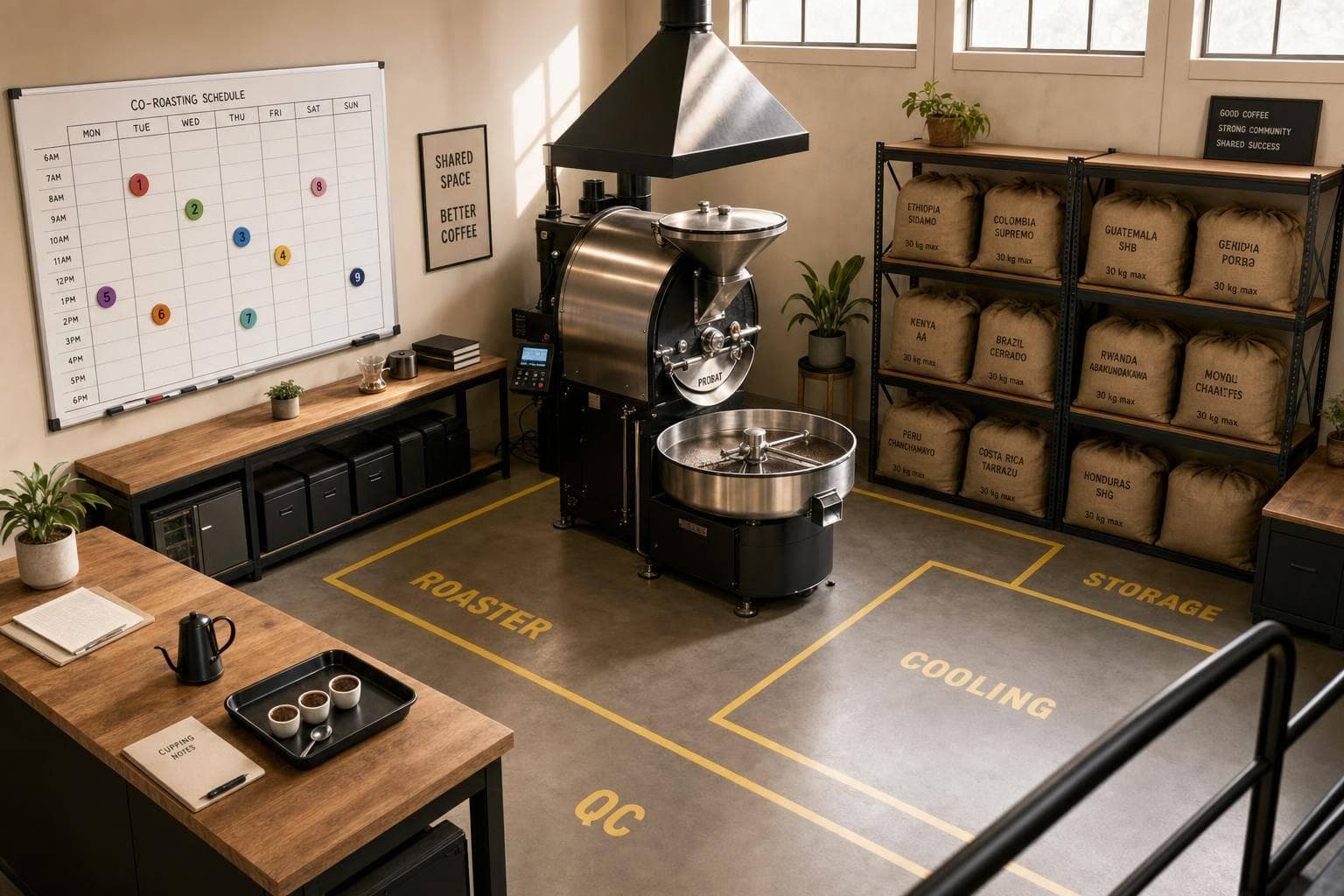
Co-Roasting Spaces: 9 Questions Answered
If you want to start roasting without spending $150,000 to $200,000+ upfront, a co-roasting space can cut that barrier fast. In most cases, you share roasters, packaging tools, storage, and lab gear, then pay by the hour or through a monthly plan. The trade-off is simple: lower startup cost, but less control over schedule, space, and day-to-day use.
Here’s the short version of what I’d want to know before booking time:
- Cost: about $50 to $400 per hour or $1,000 to $3,500 per month
- Setup fee: many spaces charge about $150 for training and safety orientation
- Storage: green coffee storage is often available, but finished goods space may cost extra
- Scheduling: members usually get better time slots; hourly users take open spots
- Quality: shared labs, roast software, sample roasters, and cupping help keep batches consistent
- Support: staff often handle maintenance and machine issues, but you still clean up after your shift
- Buying coffee: some spaces help small roasters join larger green coffee orders
- Best fit: often a good choice if you roast under 5,000 lbs. per week
- Main limit: once volume grows, shared time and storage can start to feel tight
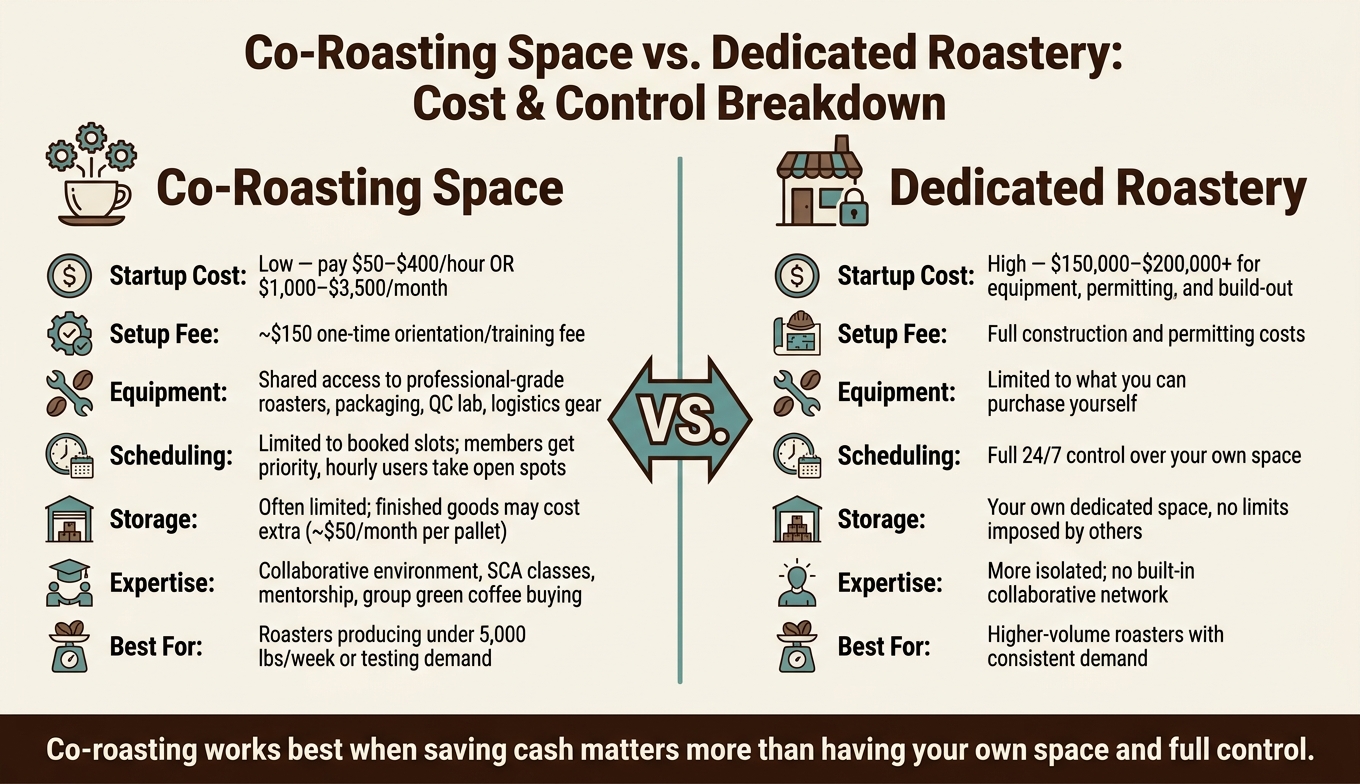
Co-Roasting Space vs. Dedicated Roastery: Cost & Control Breakdown
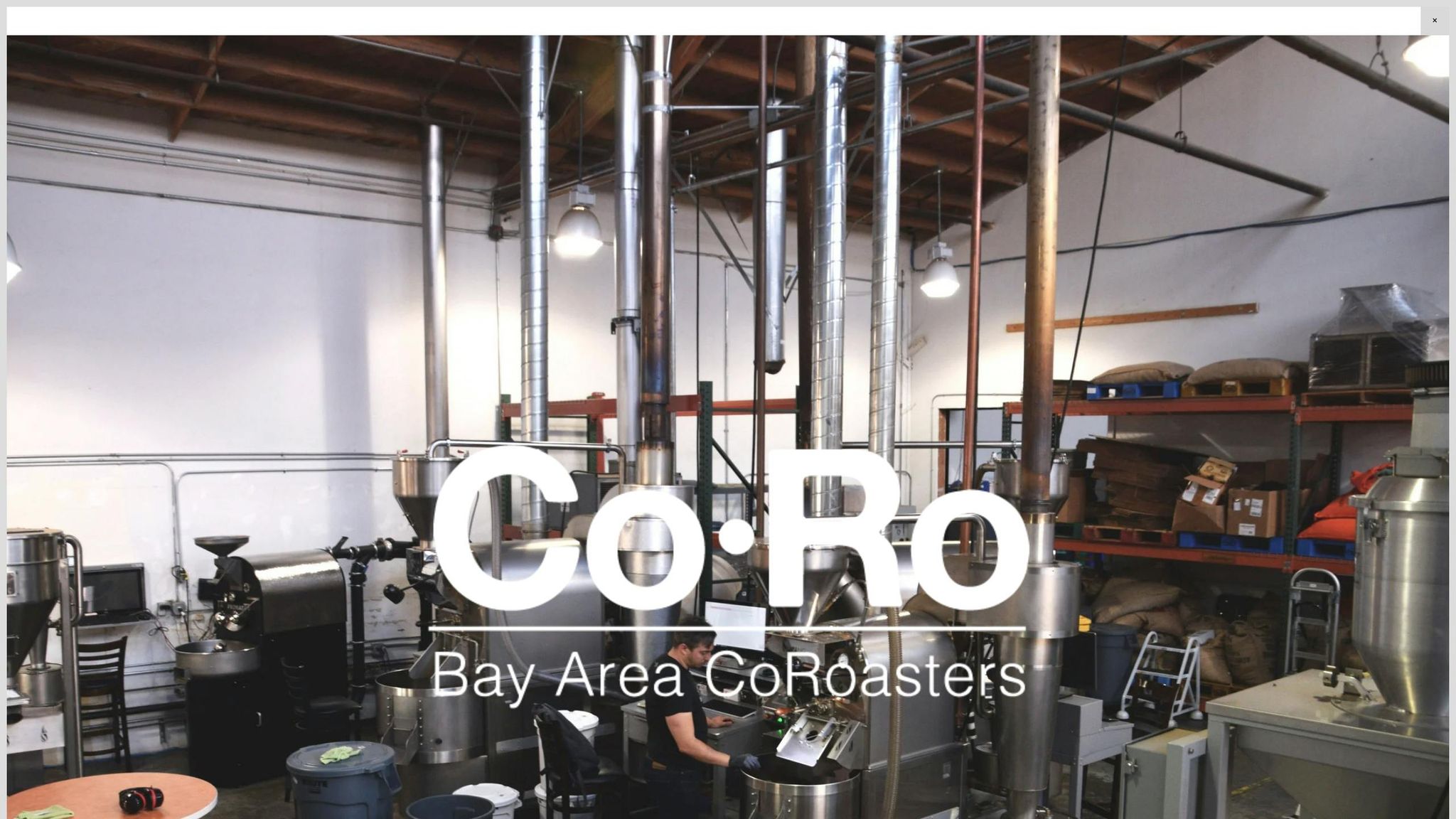
Inside the Roastery at CoRo (co-roasting space)
Quick Comparison
| Option | Upfront Cost | Access | Schedule Control | Storage | Best For |
|---|---|---|---|---|---|
| Co-roasting space | Low | Shared pro equipment | Limited to booked slots | Often limited; may cost extra | New or small roasting brands |
| Dedicated roastery | High | Your own equipment | Full control | Your own space | Higher-volume roasters |
So if I had to sum it up in one line: co-roasting works best when saving cash matters more than having your own space and full control.
The Basics: What a Co-Roasting Space Is and What You Share
A co-roasting space gives you access to roasting time, shared tools, and a working production setup without needing your own facility. You book time, use the equipment, and leave with your brand’s coffee kept separate from everyone else’s. The main things to sort out are simple: how access works, what’s shared, and what you’ll pay.
How a Co-Roasting Space Works
Most facilities charge either by the hour or through a membership. Depending on the space, roasting can be self-service, staff-assisted, or fully staff-run. Hourly rates usually fall between $60 and $400, based on machine size. Monthly memberships tend to run from $1,000 to $3,500 and often include one six-hour roasting shift per week.
That setup gives brands a few ways to work. Some want full control and roast themselves. Others would rather have staff nearby or handle the whole run. It comes down to how hands-on you want to be and how often you need production time.
Equipment and Facilities That Are Typically Shared
In most co-roasting spaces, the shared setup covers roasting, packaging, QC, and shipping equipment.
| Equipment Category | Common Items | Use |
|---|---|---|
| Roasting | Sample roasters, production roasters | Testing new lots or scaling for wholesale |
| Processing | Stone removers, moisture meters, color analyzers | Quality checks and debris removal before roasting |
| Packaging | Weigh-and-fill machines, heat sealers, labelers | Bagging retail or wholesale orders efficiently |
| QC Lab | Grinders, cupping tables, hot water towers | Evaluating roast profiles and green coffee quality |
| Logistics | Pallet jacks, scales, shipping/receiving docks | Managing deliveries and outgoing freight |
Many spaces also include roast-logging software, which helps you save profiles and repeat the same roast later without guessing.
Shared gear is a big part of the appeal, but day-to-day work also depends on storage and receiving. That’s where a lot of the practical stuff shows up.
Storage and Logistics Options in Shared Spaces
Most shared spaces can receive green coffee deliveries and offer pallet or shelf storage. Finished goods are often limited to short-term storage, and that space is usually billed separately by pallet or shelf. Before you sign anything, check the pallet limits, access hours, and how long finished goods can stay on site.
"The major benefit of using a shared roasting space is that our clients don't need to commit to a warehouse of their own, expensive equipment, and construction."
- Jeff Wong, Co-Founder, Shared Roasting
Those details shape your daily workflow more than people expect. If receiving is smooth, storage is clear, and pickup windows make sense, production tends to run with a lot less friction.
sbb-itb-af00fa5
Costs and Operations: What Daily Use Really Looks Like
How Much Co-Roasting Spaces Cost
Once storage and receiving are handled, day-to-day cost usually comes down to three things: access, training, and the time you book on the roaster.
Most spaces also charge for a safety and equipment orientation before you can use the setup on your own. That fee is often around $150.
| Feature | Monthly Membership | Hourly / Pay-As-You-Go |
|---|---|---|
| Cost | $1,000–$3,500/month | $50–$400/hour |
| Scheduling | Priority or fixed weekly slots | Book when slots are open |
| Storage | Often included or discounted | Usually an extra fee (~$50/month per pallet) |
| Commitment | Monthly advance payment | No long-term commitment |
If you're roasting at higher volume, the cost per pound tends to drop. Extra training usually starts at $75 per hour.
How Scheduling and Production Time Are Managed
Most facilities use an online calendar with 30-minute, hourly, or half-day booking blocks. Members often get priority access and recurring weekly slots. Hourly users usually grab whatever time is still open.
Your booked time often includes the full run of work:
- Profiling
- Roasting
- Cooling
- Bagging
- Cleanup
That matters because these spaces run on tight handoffs. If your slot ends at 2:00 p.m., someone else may be rolling in right after, so finishing on time isn't optional.
"Sign up for the hours you need, roast, clean up, and leave." - Ian Christopher, Co-owner, Coco Donuts
Before you book, check the fine print. Some spaces include packaging equipment, cupping lab access, or storage access in the roasting slot, while others bill those items on their own.
That day-to-day setup is one part of the choice. The next issue is whether the space can keep quality steady when multiple roasters are sharing the same setup.
Quality, Support, and Sourcing: How Roasters Keep Standards High
How Quality Control Works in Co-Roasting Spaces
After production time is booked, the next thing to check is simple: can shared equipment still produce the same result batch after batch? In many co-roasting spaces, the answer comes down to process. Facilities often use roast-tracking software, sample roasters, and on-site cupping labs to keep testing consistent. Tools like Cropster or Artisan let you compare a live roast curve with a saved reference profile as you roast.
Some spaces add another layer of control with electric roasters that store profile memory. The Stronghold, for example, can automatically repeat a saved profile. When a new lot comes in, a sample roaster such as the IKAWA helps members test small batches before moving to full production. A few facilities also standardize brew water, which helps cut down on tasting variables.
"We cup everybody's products, everybody's productions, everybody's sample roasts, everybody's importing tests, etc. We would never have tasted that many coffees in this short period of time if we had done it by ourselves." - David Boucher, Partner, Escape
What Staffing and Support Co-Roasting Spaces Provide
Equipment helps, but people keep things on track. After members finish orientation, staff usually take care of maintenance, deep cleaning, ventilation, and troubleshooting. That said, most roasters still need to clean up after their own session.
Support often goes beyond keeping the machines running. Some spaces offer SCA-certified classes, one-on-one roasting mentorship, green coffee evaluation workshops, and business training on topics like accounting and lease negotiation. That can make a big difference, especially for newer roasters who are still figuring out both production and the business side.
Insurance is another detail worth checking before you sign anything. In many cases, the facility carries general liability and equipment coverage, while members are still responsible for their own product liability.
How Green Coffee Buying and Group Purchasing Programs Work
Shared production can also change how small roasters buy green coffee. Many facilities keep sample stations where importers and growers leave green coffee for members to roast and cup, with no commission involved. That's a simple setup, but it gives smaller brands a shot at tasting more coffees without a lot of extra friction.
Group purchasing programs can take that a step further. By combining orders across members, a facility may help meet importer minimums and open the door to pricing that larger buyers usually get. Some spaces also help small roasters build direct relationships with producers, including events where farmers present their crops straight to the collective.
Making the Call: When Shared Production Makes Sense
When Co-Roasting Makes Sense for Small-Batch Roasters
Once cost, access, and support are clear, the next step is simple: does shared production fit the way you need to roast?
The strongest case for co-roasting is when you're not ready to build your own roastery. As Scott Rao notes, co-roasting lets a roaster get started without upfront equipment costs. That can be a big deal when you're still testing demand, weighing a lease or loan, or running a café that wants to bring roasting in-house.
A helpful benchmark is 5,000 lbs. per week. Under that mark, a private roastery can leave space and equipment sitting idle. And that's where shared production often looks like the smarter move.
Here’s the trade-off at a glance:
| Feature | Co-Roasting Space | Dedicated Roastery |
|---|---|---|
| Startup Cost | Low (membership or hourly fees) | High ($150,000–$200,000+ for gear, permitting, and build-out) |
| Equipment Access | Shared access to professional-grade machines | Limited to what you can purchase |
| Scheduling | Restricted to scheduled slots | Full 24/7 control |
| Shared expertise | Collaborative, shared knowledge | More isolated environment |
The main limit is flexibility. Shared production works well until your volume climbs, rush orders become common, or storage starts getting tight. Before you book time, take a hard look at your weekly output. Then check whether the booking system can handle your busiest weeks and whether green coffee storage and packaging equipment are included or billed on top of your base rate.
Conclusion: Key Trade-Offs to Review Before You Book Time
Co-roasting makes sense when lower startup cost matters more than full control. It lowers the barrier to entry, gives you access to pro equipment, and puts support close at hand while you test your business model.
Still, the trade-offs don't disappear. You won't control the schedule, storage space has limits, and costs can climb as volume grows.