Cold Brew Immersion Time and Grind Study
Cold Brew Immersion Time and Grind Study
If I want one safe starting point, I’d use a coarse grind around 1,150–1,250 microns and steep for 14–16 hours at room temperature. That range lands in the sweet spot for most immersion cold brew: enough strength, less bitterness, and fewer filter problems.
Here’s the short version:
- 8–12 hours: brighter cup, lighter body, but it can taste thin or sour
- 12–18 hours: best balance of sweetness, body, and smoothness
- 18–24+ hours: more strength, but more risk of woody, dry, or bitter notes
- Coarser grinds: slower extraction, cleaner cup, easier filtering
- Finer grinds: more strength and body, but more bitterness, cloudiness, and clogging
- Paper/felt filters: cleaner cup with less sediment
- Metal mesh: heavier body, more oils, more grit
One number stands out: in a 16-hour brew, moving from 1,200 microns to 800 microns pushed extraction from 18% to 26% and bitter compounds by 40%. So grind size doesn’t just change speed. It changes taste and filter flow too.
For brewer type, I’d keep it simple:
| Brewer | Best Starting Grind | Best Starting Time | What I’d Expect |
|---|---|---|---|
| Toddy-style | 1,200–1,350 microns | 12–18 hours | Clean cup, less sediment |
| French press | 1,300–1,450 microns | 12–18 hours | More body, some sediment |
| Metal-mesh brewer | 1,300–1,500 microns | 12–24 hours | Heaviest body, most sediment |
If I brew cold in the fridge at 35°F–40°F, I’d steep closer to 24 hours or grind a bit finer. If my filter clogs, I’d go coarser first, not shorter on time.
That’s the core takeaway: time sets how far extraction goes, grind sets how fast it gets there, and the filter shapes the final cup.
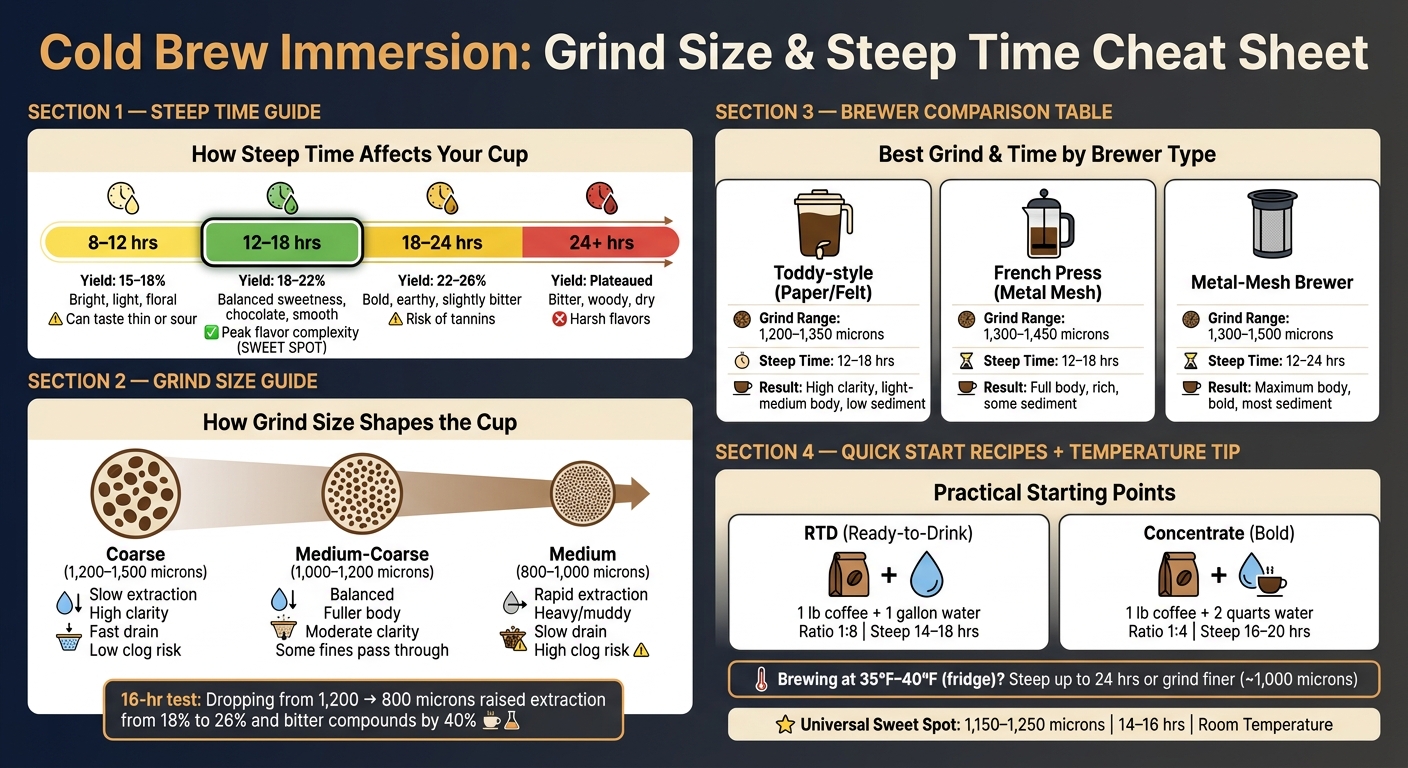
Cold Brew Grind Size & Steep Time Cheat Sheet
Back to the Basics: Cold Brew 101
sbb-itb-af00fa5
What Research Shows About Steep Time and Strength
Longer immersion increases both TDS and extraction yield, but the return drops off over time instead of climbing in a straight line. In immersion brewing, extraction usually starts with acids, then moves into sugars and aromatics, and later reaches bitter compounds. So more time doesn’t keep making the cup better. At a certain point, extraction hits its high point, then levels off or starts to slip.
Taste tests point in the same direction. Most flavor shows up in the first 8 to 12 hours, while longer steeps tend to add more body and more bitterness.
Short, Mid-Range, and Long Steeps Compared
Short steeps (8–12 hours) bring out acids and early aromatics. That usually gives you a brighter, lighter-bodied cup with a clean finish. The downside? If the brew doesn’t extract enough, it can come across as thin or a little sour. This range makes sense when timing is tight or when you want a brighter, more floral cup.
Mid-range steeps (12–18 hours) are where many commercial operations settle. Sugar and aromatic extraction is close to its high point, bitter compound pickup is still fairly low, and the body feels fuller. Many professional cold brew programs standardize an 18-hour extraction at a 1,250-micron grind because it balances efficiency with cup quality. The catch is simple: you usually need to plan it overnight.
Long steeps (18–24+ hours) produce the highest TDS and yield, but they also increase the chance of woody, tannic, or astringent notes. After 24 hours, the gains start to flatten while harsher flavors keep building.
Steep Time vs. Strength and Flavor: Comparison Table
| Steep Time | Yield | Sensory Profile | Key Tradeoff |
|---|---|---|---|
| 8–12 hours | 15–18% | Bright, light, floral | Pro: Faster turnaround; Con: Can taste thin or sour |
| 12–18 hours | 18–22% | Balanced sweetness, chocolate notes, smooth, full body | Pro: Peak flavor complexity; Con: Requires overnight planning |
| 18–24 hours | 22–26% | Bold, heavy, earthy, slightly bitter | Pro: Maximum strength; Con: Risk of tannins and astringency |
| 24+ hours | Plateaued; heavy tannin extraction | Bitter, woody, dry | Pro: Highest concentration; Con: Harsh flavors and longer turnaround |
At 65°F, plan on about 10% to 15% more time or use a slightly finer grind. At 40°F, extraction slows even more.
Time determines how far extraction can go. Grind size determines how fast it gets there. And that’s where things get interesting, because grind size can change how well those same hours pull flavor and strength from the coffee.
How Grind Size Affects Extraction, Body, and Filter Flow
Grind size shapes three big parts of a cold brew: how fast it extracts, how the cup feels, and how well it filters.
Here’s the simple version. Finer particles have more exposed surface area, so water pulls out sugars and aromatics faster. The catch? It also pulls out bitter compounds faster. And once you go finer, filtration usually gets messier too.
In one 16-hour test, dropping from 1,200 to 800 microns lifted extraction yield from 18% to 26% and bitter compounds by 40%.
Flow changes too. Fine grinds clog paper and felt filters more easily, and they let more sediment slip through metal mesh. Coarser grinds drain faster and usually leave less grit in the cup.
Coarse vs. Medium-Coarse vs. Medium in Immersion Brewing
For immersion brewing, coarse is the safest place to start. It gives you more room for error, which matters a lot when a brew is sitting for 12 hours or more.
Coarse grinds (1,200–1,500 microns) are the standard starting point for most 12- to 24-hour immersion brews. They extract slowly and evenly, which helps keep the cup clean and bitterness under control.
Medium-coarse grinds (1,000–1,200 microns) move a bit faster. They can give you more body and balanced sweetness, which is why they often work well for shorter steeps around 12 to 14 hours. But they need a closer eye. Let them run too long, and bitterness can creep in.
Medium grinds (800–1,000 microns) are much easier to push too far in immersion. They can extract fast enough that bitterness starts showing up after about 8 to 10 hours. They also tend to make the brew feel heavier and look muddier, with slower drain speed. Particles smaller than 500 microns are especially likely to slip through most home filtration systems and add grit or cloudiness to the cup.
There’s another issue that sneaks up on people: grinder consistency. Even if you choose a coarse setting, an uneven grinder can still create a pile of fine particles. Those fines extract much faster than the rest of the batch, and they’re a common reason cold brew turns bitter or clogs filters when you didn’t expect it.
Grind Category vs. Body, Clarity, and Clogging: Comparison Table
| Grind Category | Approx. Particle Range | Expected Extraction Trend | Body and Clarity | Filter Behavior |
|---|---|---|---|---|
| Coarse | 1,200–1,500 microns | Slow and gradual; low risk of over-extraction | High clarity; clean finish; lighter body | Fast drain speed; minimal sediment; low clogging risk |
| Medium-Coarse | 1,000–1,200 microns | Balanced; reaches target strength in 12–14 hours | Fuller body; balanced sweetness; moderate clarity | Moderate drain; some fine particles pass through metal filters |
| Medium | 800–1,000 microns | Rapid; higher bitterness risk after 8–10 hours | Heavy body; muddy texture; low clarity | Slow drain; higher clogging risk for paper and felt filters |
If you’re making concentrate at ratios of 1:4 to 1:6, going a touch coarser, around 1,300 to 1,500 microns, helps stop bitter compounds from taking over the final cup.
How Steep Time and Grind Size Work Together
Grind size controls how fast coffee extracts. Steep time decides how far that extraction goes. Put those two together, and you get the core of cold brew dialing in.
But there’s one more piece that changes everything: filtration.
Once a filter gets involved, the same grind and the same steep time can lead to a very different cup. That’s why cold brew from a Toddy doesn’t land the same way as cold brew from a French press, even if you use similar coffee and water.
Time and Grind Patterns for Toddy, French Press, and Metal-Mesh Brewers
The best grind-and-time combo depends on the brewer because the filter changes how much body, oil, and sediment make it into the final cup.
Toddy-style systems use paper or felt filters. Those filters catch oils and fine particles, which leads to high clarity and a light-to-medium body. A coarse to medium-coarse grind, around 1,200–1,350 microns, with a 12- to 18-hour steep is a solid place to start.
French press brewers use a metal mesh plunger, so more oils pass through. That gives the coffee more body and a heavier texture. A coarser grind, around 1,300–1,450 microns, helps keep the filter from clogging and keeps sediment at a level most people can live with. After steeping, let the brew settle for 5 to 8 minutes before pouring to cut down on sediment.
Metal-mesh brewers let through the most oils and usually make the heaviest cup. For these, an extra coarse grind of 1,300–1,500 microns works best, along with a 12- to 24-hour steep window. That combo helps keep flow moving and lowers the odds of a muddy result.
These brewer-specific ranges are summarized below. You can also discover independent coffee roasters to find beans specifically roasted for these methods.
Best Time-Grind Pair by Immersion System: Comparison Table
| Immersion System | Recommended Grind Range | Typical Steep Window | Strength and Body Result | Filter/Sediment Considerations |
|---|---|---|---|---|
| Toddy-style (Paper/Felt) | Coarse to Medium-Coarse (1,200–1,350 microns) | 12–18+ hours | High clarity, balanced sweetness, light-to-medium body | Paper/felt filters remove most oils and fines; very low sediment |
| French Press | Coarse (1,300–1,450 microns) | 12–18 hours | Full body, textured mouthfeel, rich flavors | Metal mesh allows more oils and some sediment; coarser grind helps prevent clogging |
| Metal-Mesh Brewers | Extra Coarse (1,300–1,500 microns) | 12–24 hours | Maximum body, heavy mouthfeel, bold intensity | Highest sediment levels; requires extra coarse particles to maintain flow |
Practical Starting Points for U.S. Roasters and Home Brewers
Starting Recipe Ranges and Filter Choices
Using the time and grind ranges above, these are the most dependable starting recipes for immersion brewers. A good place to begin is 1:8 for ready-to-drink cold brew or 1:4 for concentrate.
| Brew Goal | Coffee | Water | Ratio | Steep Time |
|---|---|---|---|---|
| RTD (Balanced) | 1 lb (16 oz) | 1 gallon (128 oz) | 1:8 | 14–18 hours |
| Concentrate (Bold) | 1 lb (16 oz) | 2 quarts (64 oz) | 1:4 | 16–20 hours |
Your filter changes the cup more than many people expect. Paper or felt gives you a cleaner result. Metal mesh lets more oils and fine particles through, which adds body.
If your brew has too much sediment or the filter keeps clogging, go coarser before you cut steep time.
Cold storage slows extraction, so you may need to change either time or grind. At 35°F–40°F, push the steep closer to the 24-hour mark or grind a bit finer, closer to 1,000 microns, to get strength closer to a room-temperature brew.
Conclusion: Key Findings on Strength, Body, and Filtration
Steep time drives strength. Grind size affects how fast extraction happens. The filter decides how much body and sediment end up in the cup.
For most immersion brewers, start around 1,150–1,250 microns and 14–16 hours at room temperature. Toddy-style brewers work better with a coarser grind. French press and metal-mesh systems need the coarsest settings to keep the flow open.
FAQs
How do I adjust time if I brew in the fridge?
In the fridge, steep time should match the kind of cup you want. 12 hours usually keeps more brightness, acidity, and clean flavor. Push it to 24 hours, and you’ll often get more body and sweetness, but darker roasts can start to pick up woody or bitter notes.
Grind size has a big effect on how fast coffee extracts, so it usually makes sense to tweak the grind first. Then use steep time as a smaller adjustment to dial things in.
What grind should I use for concentrate?
For cold brew concentrate, use an extra-coarse grind. Think raw sugar, coarse sea salt, or crushed peppercorns. That kind of grind helps prevent over-extraction and bitterness during a 12 to 24-hour steep.
If your concentrate tastes muddy or bitter, go a bit coarser. If it feels flat or thin, try grinding slightly finer.
Why does my cold brew taste bitter or gritty?
That bitter, muddy taste usually points to over-extraction. Most of the time, that happens when the grind is too fine or the steep time runs too long. A fine grind can also leave behind more sediment, which gives the brew that gritty, cloudy feel.
A better move is to use a coarse grind about the size of sea salt or raw sugar. If the brew still comes out bitter, cut back the steep time. Once you go past 18 to 20 hours, you can start pulling out astringent flavors without getting more depth.