Roasted Coffee Cottage Food Rules: 32-State List
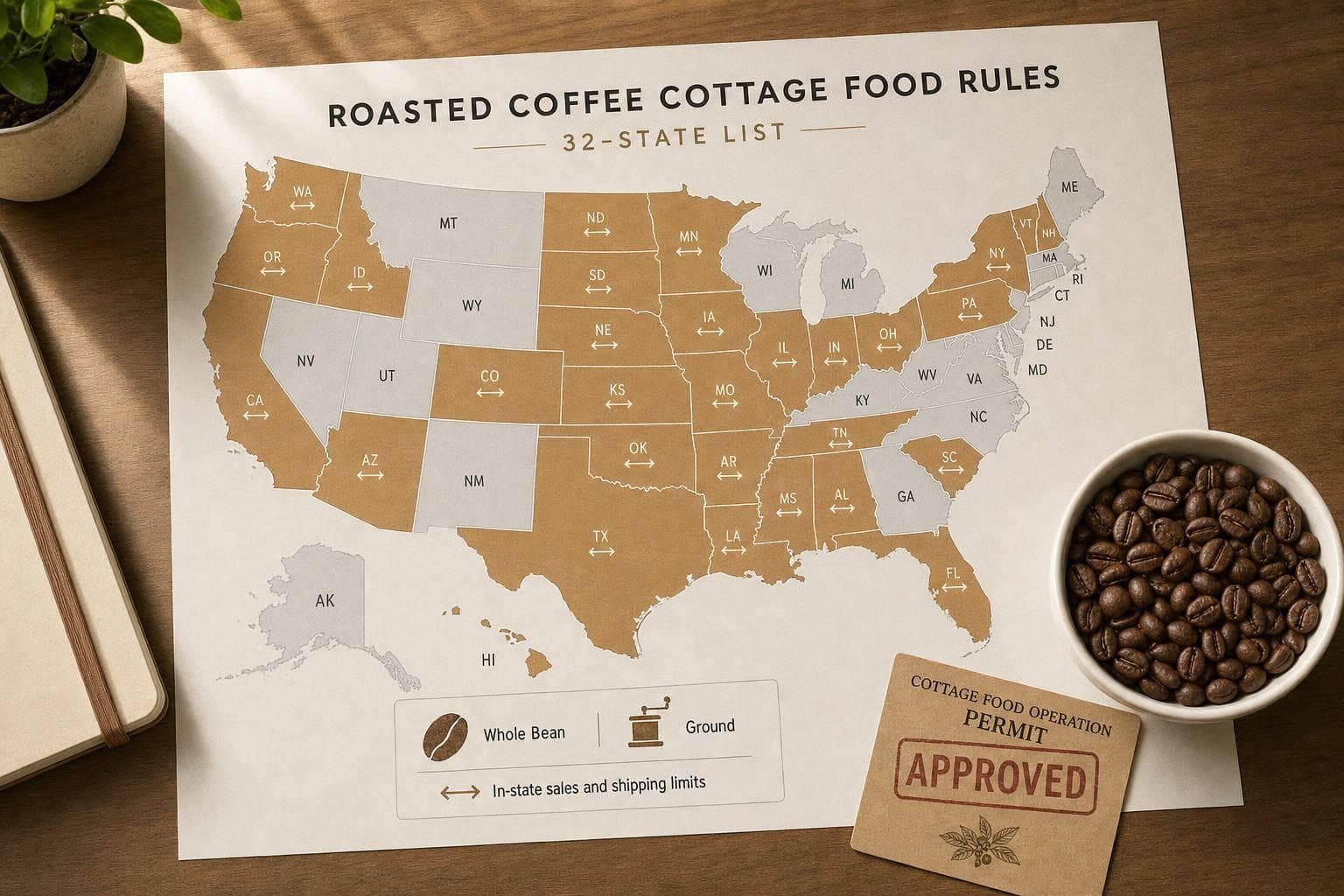
Roasted Coffee Cottage Food Rules: 32-State List
If you want to sell roasted coffee from home, the answer changes by state fast. As of July 23, 2026, some states plainly allow it, some allow only whole bean coffee, and some block home roasting under cottage food rules.
Here’s the short answer:
- I found a big split between states
- Florida allows home cottage food sales up to $250,000 a year
- New York does not allow home roasting or grinding under its home food exemption
- In some states, whole bean is allowed but ground coffee is not
- In many states, in-state direct sales are the main path
- Interstate shipping is usually off-limits under cottage food rules
- Permits range from none to state or local registration, training, or a permit
This guide covers 32 states in the article content provided and looks at the points most sellers care about:
- whether roasted coffee is allowed
- whether you can sell direct to buyers
- whether you can ship inside your state
- whether a permit or registration is needed
- whether the rules treat whole bean and ground coffee differently
A few states are easy reads. Others are gray areas where the published rules do not give a clean yes or no. That matters, because one word like “roasted beans” versus “ground coffee” can change what you can sell from your home kitchen.
How to Start a Coffee Roasting Business From Your Home
sbb-itb-af00fa5
Quick comparison
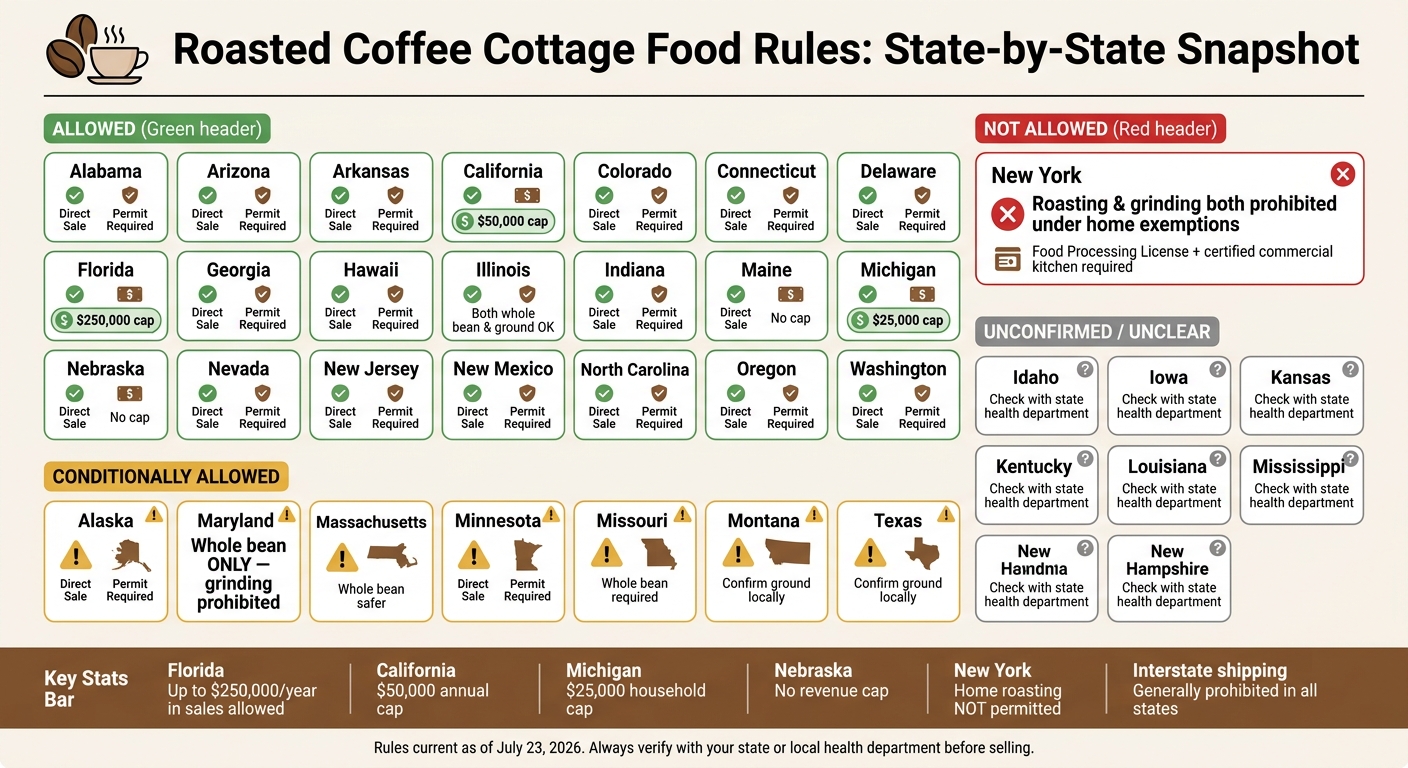
Roasted Coffee Cottage Food Rules by State: Quick-Reference Guide
| State status type | What it means for you |
|---|---|
| Allowed | Roasted coffee usually fits cottage food rules |
| Conditionally Allowed | Coffee may be allowed, but extra limits apply |
| Not Clearly Allowed / Unconfirmed | The state rule is unclear or not confirmed in the source |
| Not Allowed | Home roasting does not fit cottage food rules |
In plain English: check your state first, then check whether grinding, shipping, or local permits change the answer. That’s the main point of this list.
How to Use This 50-State Coffee Law Guide
Start with the status label. Then look at sales, shipping, permits, and any notes about whole bean versus ground coffee.
That first label gives you the fast answer: can you sell roasted coffee from home under cottage food rules, or not?
Status Labels Used in This Guide
This guide uses three labels:
- Allowed means roasted coffee is plainly listed as an approved cottage food item, or it fits a shelf-stable, low-moisture category.
- Conditionally Allowed means coffee can be sold, but only if you meet extra rules like permits, registration, or limits on selling only certain forms, such as whole bean.
- Not Clearly Allowed means the state either shuts the door on home roasting or moves it into commercial licensing rules.
After that, check the state's rules on sales and shipping.
What Counts as a Direct Sale
A direct sale means the product goes straight from the producer to the customer, with no middleman in between. That often includes farmers markets, roadside stands, home pickup, community events, and direct online orders delivered inside the state.
Indirect sales are a different story. Selling through cafes, restaurants, grocery stores, or specialty retailers usually falls outside cottage food rules in most states. The Nebraska Department of Agriculture says it plainly:
"The cottage food law states that you must hand the product directly to the consumer or mail it directly to the consumer. There cannot be a third party involved, even if everyone knows you."
What "Shipping Allowed" Usually Means
If a state says shipping is allowed, that usually means in-state shipping only. Shipping across state lines often triggers federal FDA registration and commercial food facility licensing rules, which go past cottage food law.
A lot of states also bar third-party handling. In plain English: you have to ship the order straight to the buyer.
There’s one more thing to check, and it matters more than many people expect: whether the state treats whole bean and ground coffee the same way.
Why Ground Coffee Can Be Treated Differently
Grinding coffee can count as extra processing. Once that happens, the product may no longer fit cottage food status. Whole bean coffee is more often treated as a shelf-stable product with only light processing.
Maryland shows how this can play out. Whole beans are allowed, but grinding the coffee knocks it out of cottage food status. As Evan Knox, Cofounder of Homegrown, explains:
"Some states allow whole bean but not ground coffee. Maryland, for example, considers grinding to be 'further processing' that goes beyond cottage food."
So if your state's approved food list says "roasted coffee beans" and says nothing about "ground coffee," take that as a cue to double-check before selling pre-ground coffee.
50-State Roasted Coffee Status Snapshot
With those ground rules in place, this snapshot shows how much state rules can vary. In some places, you can sell from home with few limits. In others, sales are capped, shipping is limited, or grinding is off the table.
The table below pulls together the main rules for each state covered here: status, direct sales, shipping, permits, sales caps, and whether the rules treat whole bean and ground coffee differently.
| State | Status | Direct Sale | Shipping | Permit Required | Sales Cap | Whole Bean vs. Ground |
|---|---|---|---|---|---|---|
| California | Allowed | Yes | Unclear | Yes (Class A or B) | $50,000 | Not specified |
| Florida | Allowed | Yes | In-state | No | $250,000 | Pre-packaged only; no brewed beverages |
| Illinois | Allowed | Yes | In-state | Yes (CFO Permit) | Not specified | Not specified |
| Maine | Allowed | Yes | In-state | No | Not specified | Not specified |
| Maryland | Restricted | Yes | Unclear | Unclear | Not specified | Whole bean allowed; ground prohibited |
| New York | Prohibited | No | No | N/A | N/A | Roasting and grinding both prohibited |
| North Carolina | Allowed | Yes | Unclear | Yes | $50,000 | Not specified |
| Oregon | Allowed | Yes | Online allowed | Yes (Domestic kitchen permit for some operations) | Not specified | Not specified |
| Texas | Conditional | Yes | Unclear | No | Not specified | Roasted beans allowed; brewed beverages may be restricted |
| Washington | Allowed | Yes | No | Unclear | Not specified | Direct-to-consumer only |
Unclear means the published rules do not say. Check your local health department before selling.
1. Alabama
Status: Allowed
Here’s the short version for Alabama.
Alabama allows roasted coffee under cottage food rules. In most cases, direct sales include farmers markets, roadside stands, home pickup, and direct delivery to the customer.
Shipping: not clearly stated.
Common requirements include local health department registration and a CFO permit. Before you start selling, check with your county health department for any local rules.
Whole bean vs. ground: not specified.
2. Alaska
Alaska: Conditionally Allowed
Alaska treats roasted coffee as a cottage food, but there are a few strings attached.
You generally need to sell directly to the customer. That usually means places like farmers markets, roadside stands, or local pre-orders.
Shipping: the rule isn't clearly stated, so it's smart to check mailing rules with the Alaska Department of Environmental Conservation before you ship anything.
You'll also need registration, and food handler certification may apply too.
Whole bean vs. ground: Alaska doesn't state a separate rule for whole bean coffee versus ground coffee.
3. Arizona
Arizona: Allowed
Arizona is a workable cottage food state for roasted coffee, but shipping and grind status need a closer look.
Arizona allows roasted coffee under its cottage food rules. Direct sales usually include farmers markets, roadside stands, and home pickup.
Shipping: unclear.
To sell, you need to register as a cottage food producer and complete the required food-handler certification. Labels usually need to include:
- Business name
- Product name
- Net weight
- Ingredients
- Roast date
- Required cottage food disclaimer
Whole bean vs. ground: not specified.
4. Arkansas
Arkansas: Allowed
Arkansas generally allows roasted coffee beans under cottage food rules. The quick scan is simple here: check direct sales first, then look at shipping, permits, and whether the state treats whole bean and ground coffee differently.
Typical direct sales include:
- farmers markets
- home pickup
- roadside stands
- fairs
- community events
Shipping: not clearly stated.
Permit: not clearly stated.
Labeling must follow Arkansas cottage food requirements.
Whole bean vs. ground: no separate Arkansas distinction noted.
5. California
California: Allowed
California is one of the clearest states for cottage food coffee. Roasted coffee is allowed, which makes the state fairly straightforward for home-based sellers. That said, the permit route still matters, and so do the limits around shipping.
California uses Class A and Class B cottage food permits. Class A covers direct sales only. Class B also allows indirect sales, which means you can sell through local retailers, cafes, and restaurants. Direct sales are allowed under Class A permits. On top of the cottage food permit, you may also need other approvals, such as registration, a food handler requirement, a seller's permit, and a local business license.
Shipping: Interstate shipping is outside cottage food rules and triggers federal FDA registration requirements.
Revenue cap: California has a $50,000 annual gross sales cap.
Whole bean vs. ground: California sources talk about roasted coffee in broad terms, but ground coffee may sit outside cottage food rules because grinding can count as extra processing. So if you're planning to sell ground coffee, check with your county health department first. Whole bean is the safer place to start.
Next, it helps to see whether the next state uses a similar direct-sale setup or puts tighter limits in place.
6. Colorado
Colorado: Allowed
Colorado plainly lists roasted coffee as an approved cottage food product.
You can sell direct to consumers through places like farmers markets, roadside stands, and online pre-orders that are shipped or delivered within Colorado. But sales through third-party retailers or wholesalers are outside cottage food protections. Before you start selling, register as a cottage food producer and complete any required food handler training.
Shipping: Colorado doesn't clearly say how out-of-state orders are handled. In-state direct delivery does fit the direct-to-consumer model.
Whole bean vs. ground: Colorado doesn't clearly separate whole bean coffee from ground coffee. That gray area matters. Some local health departments treat grinding as extra processing, so it's smart to check local rules first. If anything feels unclear, starting with whole bean coffee is the safer move.
Each package must include:
- A cottage food disclaimer
- Business name and address
- Net weight
- Roast date
The next state takes a different path on sales and processing.
7. Connecticut
Connecticut: Allowed
Connecticut is one of the clearer yes-states for roasted coffee. The state directly lists roasted coffee as an approved cottage food product.
For sales, you can sell at farmers markets and take online pre-orders.
Shipping isn't clearly spelled out in the rule, so that part sits in a gray area.
To get started, you'll need to register as a cottage food producer. A food handler certification may also apply.
As for whole bean vs. ground, Connecticut doesn't list a separate rule for that. So if you're looking for the safer path, whole bean is the better place to start.
Your label should include:
- Product name
- Roast level
- Net weight
- Roast date
- Business name and address
- Ingredients
- The cottage food disclaimer
Next, check how Delaware treats direct sales, shipping, and grinding.
8. Delaware
Status: Allowed
Roasted coffee is generally allowed as a cottage food product in Delaware. So the next step is less about whether you can sell it and more about how you sell it.
Direct sales usually include farmers markets, roadside stands, and face-to-face pickup. Intrastate online orders may also be allowed.
Before you start selling, check whether you need to register with the local health department or get a cottage food permit. Food handler certification may apply too.
Use the standard cottage food label.
If you're deciding between formats, whole-bean coffee is usually the safer pick unless Delaware clearly says ground coffee is allowed.
Next, compare Delaware's rules with the following state's sales limits and permit requirements.
9. Florida
Status: Allowed
Florida allows roasted coffee under its cottage food law. That includes both whole bean and ground coffee. The key rule is simple: sell it pre-packaged and use the required label.
Florida’s annual gross sales cap is $250,000.
You can sell directly to consumers only. That covers places like:
- farmers markets
- roadside stands
- in-state online orders
Sales to retailers, cafes, and restaurants are outside Florida’s cottage food rules.
After that, compliance is pretty straightforward. You don’t need a permit, and the state doesn’t require an inspection. The main thing to get right is labeling. Each package must include the business name, full address, net weight in both ounces and grams, allergen disclosures, and the state-required disclaimer.
One thing to watch: flavored beans or added oils may need a separate product review. If you want the cleanest path, plain roasted coffee, whether whole bean or ground, is the safest fit.
Next up: Georgia's cottage food rules for roasted coffee.
10. Georgia
Status: Allowed
Georgia allows roasted coffee under its cottage food rules.
Like many cottage food states, Georgia keeps sales direct. You can usually sell straight to the customer through places like farmers markets, roadside stands, and home sales. Online orders also usually need to stay in-state.
To get started, register as a cottage food producer and complete any food handler training the state requires. One thing to note: Georgia's rule summary doesn't clearly split out whole bean coffee from ground coffee.
Next up: Hawaii's roasted coffee rules.
11. Hawaii
Status: Allowed
Hawaii generally treats roasted coffee as an NPH food.
That means direct sales are usually allowed through channels like farmers markets, home pickup, and local delivery.
Shipping: not clearly stated.
From there, the main to-do list comes down to licensing and food-safety training. Typical requirements include a business license, seller's permit, and food-safety certification.
Whole bean vs. ground: Hawaii does not appear to make a separate distinction between whole bean and ground coffee.
Next: Idaho.
12. Idaho
Status: Not clearly specified in the source material
The source material does not give Idaho-specific rules for roasted coffee.
That said, roasted coffee is often treated as a non-potentially hazardous, shelf-stable, low-moisture food. That’s why many states allow it under cottage food laws.
Direct sales and shipping: The source material does not spell out Idaho-only limits for direct sales or shipping of roasted coffee.
Permits and labeling: In places where coffee roasting is allowed, sellers are often expected to list the product name, net weight, ingredients, and a disclaimer on the label.
Whole bean vs. ground: Many cottage food laws cover both roasted whole beans and ground coffee. But there’s a catch: some states treat grinding as extra processing, which can push the product outside cottage food rules.
Next: Illinois.
13. Illinois
Status: Allowed - roasted coffee is allowed under Illinois cottage food rules.
Illinois allows roasted coffee under its cottage food rules, but sales must stay direct and in-state.
Here’s the short version:
| Requirement | Illinois Rule |
|---|---|
| Roasted Coffee Allowed | Yes - approved cottage food item |
| Permit Required | Cottage Food Operator (CFO) permit; register with the local health department |
| Direct Sales | Allowed at farmers markets, roadside stands, and other direct-sales venues |
| Online Sales / Shipping | Allowed within Illinois; interstate shipping generally prohibited |
| Wholesale / Indirect Sales | Prohibited |
| Whole Bean vs. Ground | Both allowed |
| Labeling | Business name and address, product name, ingredients, net weight, and disclaimer required |
A few details matter here. Illinois lets you sell both whole bean and ground coffee under cottage food rules. You can also sell online, but only within Illinois. Shipping across state lines is generally not allowed.
You’ll also need a Cottage Food Operator (CFO) permit and must register with your local health department. And if you were hoping to sell wholesale to stores, that’s off the table under these rules.
Next: Indiana.
14. Indiana
Status: Allowed - roasted coffee qualifies as a low-risk, shelf-stable cottage food item.
Here’s the quick compliance snapshot.
| Requirement | Indiana Rule |
|---|---|
| Roasted Coffee Allowed | Yes - treated as a low-risk, shelf-stable cottage food item |
| Permit / Registration | Registration as a cottage food producer required |
| Food-Handler Certification | Required |
| Direct Sales | Allowed at farmers markets, roadside stands, and home pickup |
| Shipping | Not clearly stated |
| Whole Bean vs. Ground | Both allowed |
To sell roasted coffee in Indiana, you need to register as a cottage food producer and complete the required food-handler certification. You can sell either whole bean or ground coffee, which keeps things pretty simple if you want to offer more than one format.
Direct sales are allowed at farmers markets, roadside stands, and through home pickup. Shipping, though, isn’t clearly stated in the source, so that part needs extra care.
Next: Iowa.
15. Iowa
Status: Not clearly confirmed for Iowa.
Iowa is a bit of a gray area here. Based on the source material, roasted coffee is not clearly listed as an approved cottage food item. So before you worry about permits, inspections, or sales channels, the main issue is more basic: does Iowa allow it under cottage food rules at all?
| Requirement | Iowa Rule |
|---|---|
| Roasted Coffee Allowed | Not clearly confirmed in the source material |
| Permit / Registration | Not specified |
| Kitchen Inspection | Not specified |
| Direct Sales | Not specified |
| Online / Shipping | Not specified |
| Whole Bean vs. Ground | No Iowa-specific distinction identified |
As it stands, no Iowa-specific permit rule, inspection rule, or whole bean vs. ground rule is identified here.
Next: Kansas, where the coffee rules need the same close read.
16. Kansas
Status: Not clearly confirmed for Kansas.
Kansas is not clearly confirmed in the source material as allowing roasted coffee under cottage food rules. So if you're looking for a clean yes-or-no answer here, the source doesn't give one.
The table below shows what is and is not confirmed.
| Requirement | Kansas Rule |
|---|---|
| Roasted Coffee Allowed | Not clearly confirmed in the source material |
| Permit / Registration | Not specified |
| Kitchen Inspection | Not specified |
| Direct Sales | Not specified |
| Online / Shipping | Not specified |
| Whole Bean vs. Ground | No Kansas-specific distinction identified |
No Kansas-specific approval, permit, inspection, sales, or shipping rule is identified in the source material. There also isn't a Kansas-specific rule in the source that separates whole bean from ground coffee.
Next up: Kentucky.
17. Kentucky
Status: Not confirmed in the provided source material.
The source material does not spell out Kentucky’s rules for roasted coffee, so Kentucky stays unconfirmed here. For now, this is the current Kentucky snapshot.
| Requirement | Kentucky Rule |
|---|---|
| Roasted Coffee Allowed | Not confirmed in the provided source material |
| Permit / Registration | Not specified in the provided source material |
| Kitchen Inspection | Not specified |
| Direct Sales | Not specified in the provided source material |
| Online / Shipping | Not specified |
| Whole Bean vs. Ground | Not specified in the provided source material |
Next: Louisiana.
18. Louisiana
Louisiana's roasted coffee rules are not confirmed in the provided source material. So for this state, the source does not confirm any Louisiana-specific rule for sales, shipping, permits, or home kitchen use.
That means Louisiana is unconfirmed in the source material, and the next state is Maine.
| Requirement | Louisiana Rule |
|---|---|
| Roasted Coffee Allowed | Not specified |
| Permit / Registration | Not specified |
| Kitchen Inspection | Not specified |
| Direct Sales | Not specified |
| Online / Shipping | Not specified |
| Whole Bean vs. Ground | Not specified |
Next: Maine.
19. Maine
Maine lets you sell roasted coffee under its cottage food rules, and the state treats whole bean and ground coffee the same.
If you sell direct to consumers and stay under the revenue cap, you don't need a state license. Your home kitchen also doesn't need an inspection.
Direct sales are allowed in a few common places:
- From home
- At farmers markets
- At fairs
- At community events
Online sales are more limited. You can sell online only to buyers in Maine. Shipping out of state isn't allowed. And if you want to sell wholesale, you'll need a separate commercial food processing license.
Each bag has to include your business name and address, the ingredients, and the required home-kitchen disclaimer.
| Requirement | Maine Rule |
|---|---|
| Roasted Coffee Allowed | Yes (whole bean and ground) |
| License Required | No (for direct-to-consumer sales under threshold) |
| Kitchen Inspection | Not required |
| Direct Sales | Allowed (home, farmers markets, fairs, community events) |
| Online / Shipping | Intrastate only |
| Wholesale | Prohibited without a separate license |
| Labeling Disclaimer | Required (made in a home kitchen not inspected by the state) |
Next: Maryland, where grinding changes the answer.
20. Maryland
Status: Conditionally Allowed
Maryland is a narrower yes than a lot of other states.
You can generally sell roasted coffee as a cottage food. Whole bean coffee is allowed, but ground coffee is usually not. In Maryland, grinding is often treated as extra processing, which means ground coffee tends to fall outside cottage food rules.
If you want to stay on the safe side, sell whole beans only.
Before you start selling, check with your county health department. Registration may be required, and some counties may also ask for food-handler certification.
Each bag should include:
- Product name
- Net weight
- Roast date
- Business name and address
- Ingredients
- Cottage-food disclaimer
| Requirement | Maryland Rule |
|---|---|
| Roasted Coffee Allowed | Yes, generally |
| Whole Bean | Allowed |
| Ground Coffee | Usually excluded |
| Registration | May be required; check with your county health department |
| Food Handler Certification | May be required |
| Direct Sales | Farmers markets |
| Labeling | Product name, net weight, roast date, business name/address, ingredients, cottage food disclaimer |
Next: Massachusetts, where the permit and sales rules change again.
21. Massachusetts
Status: Conditionally Allowed
Massachusetts generally treats roasted coffee as a cottage food. Whole bean coffee is the safer bet. Ground coffee may not qualify if grinding is treated as extra processing.
Before you start selling, check with your local board of health. You may also need a food handler permit.
Direct sales can include:
- farmers markets
- online pre-orders
- home delivery
- subscriptions
Shipping may also be allowed, but it’s smart to confirm local rules first.
| Requirement | Massachusetts Rule |
|---|---|
| Roasted Coffee Allowed | Yes, generally |
| Whole Bean | Allowed |
| Ground Coffee | May be excluded; check locally |
| Local Approval | Check with your local board of health |
| Food Handler's Permit | May be required |
| Direct Sales | Farmers markets, online pre-orders, home delivery, subscriptions |
| Shipping | May be allowed; verify locally |
Next up: Michigan.
22. Michigan
Status: Allowed
Michigan allows roasted coffee under its cottage food rules, including whole bean and ground coffee. You don't need state registration, a license, or a pre-sale inspection to sell it. The sales cap is $25,000 per household.
Here’s the fast compliance snapshot.
| Requirement | Michigan Rule |
|---|---|
| Roasted Coffee Allowed | Yes |
| Whole Bean | Allowed |
| Ground Coffee | Allowed |
| Registration/License | Not required |
| Sales Cap | $25,000 per household |
| Direct Sales | Farmers markets, roadside stands, home sales |
Next: Minnesota.
23. Minnesota
Status: Generally Allowed
Minnesota is generally a yes state. That said, there’s one detail worth checking: grinding may change how the product is treated. If the state sees ground coffee as more processing, the rules for it may differ from whole bean coffee.
For most sellers, direct sales are the main path in Minnesota. That includes farmers markets, roadside stands, fairs, community events, and online pre-orders.
Shipping: Not clearly stated.
Permit: Registration may be required.
Minnesota snapshot:
| Requirement | Minnesota Rule |
|---|---|
| Roasted Coffee Allowed | Generally allowed |
| Whole Bean | Generally allowed |
| Ground Coffee | May be regulated differently |
| Registration | May be required |
| Direct Sales | Farmers markets, roadside stands, fairs, community events, online pre-orders |
| Shipping | Not clearly stated |
| Indirect Sales (retailers/cafes) | Generally not permitted |
Next: Mississippi.
24. Mississippi
Status: Not clearly specified
Mississippi sits in the same gray area as several other states in the source material.
Based on the sources provided, there isn't a clear Mississippi rule for roasted coffee. That includes whole bean coffee, ground coffee, direct sales, shipping, and any permit or registration tied to those sales.
| Requirement | Mississippi Rule |
|---|---|
| Roasted Coffee Allowed | Not specified |
| Whole Bean | Not specified |
| Ground Coffee | Not specified |
| Registration / Permit | Not specified |
| Direct Sales | Not specified |
| Shipping | Not specified |
Next: Missouri.
25. Missouri
Status: Conditionally Allowed
Missouri is more clear-cut than the unconfirmed states above, but home roasters still need to follow direct-sale cottage food rules.
In general, Missouri allows roasted coffee as a dry, shelf-stable cottage food. That means both whole bean and ground coffee are usually allowed. Direct sales typically cover places and methods like farmers markets, home pickup, and direct delivery.
There’s a catch, though. Registration is required, and you also need to follow labeling rules and any local health department requirements.
| Requirement | Missouri Rule |
|---|---|
| Roasted Coffee Allowed | Yes (generally eligible) |
| Whole Bean | Allowed |
| Ground Coffee | Allowed |
| Registration / Local Requirements | Registration required; labeling and local health department rules apply |
| Direct Sales | Allowed (farmers markets, home pickup, direct delivery) |
| Shipping | Not specified |
Next: Montana.
26. Montana
Status: Conditionally Allowed
Montana is a conditional yes, but the state's guidance is short and a bit light on detail.
In most cases, Montana treats roasted coffee as a dry, shelf-stable cottage food. Whole bean coffee is usually the safer option. Ground coffee may still fit, but it's smart to check with your local authority before you start selling. Registration may be required, and food handler certification may also apply.
| Requirement | Montana Rule |
|---|---|
| Roasted Coffee Allowed | Generally eligible |
| Whole Bean | Often allowed |
| Ground Coffee | Confirm locally |
| Registration / Permit | Registration may be required; food handler certification may apply |
| Direct Sales | Direct-to-consumer sales are the main channel |
| Shipping | Not clearly stated |
Next: Nebraska.
27. Nebraska
Status: Allowed
Nebraska is one of the clearest yes-states in this group.
Under LB 304, the state allows home-based roasted coffee sales, including whole bean and ground coffee.
Roasting can happen in a home kitchen or in a protected garage, as long as the space is shielded from contamination. As Nebraska Extension notes:
"Roasting in your garage is acceptable if the area is effectively protected from contamination. You will also need to post your sign about it being prepared in a kitchen that is not regulated."
Sales must go directly to the consumer. That includes pickup, delivery, public events, and direct online orders. The Nebraska Department of Agriculture also states:
"The cottage food law states that you must hand the product directly to the consumer or mail it directly to the consumer. There cannot be a third party involved."
That last part matters. You can ship, but only to Nebraska addresses. Interstate shipping is not allowed. Nebraska also does not set an annual revenue cap for cottage food sales.
| Requirement | Nebraska Rule |
|---|---|
| Roasted Coffee Allowed | Yes - whole bean and ground |
| Registration / Permit | One-time Nebraska Department of Agriculture registration required for non-farmers-market sales |
| Food Safety Training | Required at least once |
| Direct Sales | Required - direct to consumer only |
| In-State Shipping | Permitted |
| Interstate Shipping | Prohibited |
| Revenue Cap | None |
Each package must include your name and address, ingredients listed by weight, and the allergen disclaimer.
Next: Nevada.
28. Nevada
Status: Allowed with Restrictions
Nevada generally treats roasted coffee as eligible under cottage food rules. So the big issue usually isn't can you roast coffee? It's whether you sell it through approved direct channels and keep those sales in-state.
Direct sales include farmers' markets, roadside stands, and sales from your home. If you roast from home, you need to register with the state or your local health authority before you start selling. It also makes sense to check with your local health department, since extra local rules may apply.
Nevada is fairly open on this point, but the registration step still matters.
| Requirement | Nevada Rule |
|---|---|
| Roasted Coffee Allowed | Generally eligible as a low-risk cottage food |
| Registration / Permit | Registration required with the state or local health authority |
| Direct Sales | Permitted (farmers' markets, roadside stands, home) |
| Shipping | Not clearly stated; verify whether only in-state shipping is allowed |
| Whole Bean vs. Ground | Both are described as low-risk, shelf-stable foods |
Next: New Hampshire.
29. New Hampshire
Status: Not clearly confirmed in the provided sources
The sources provided don't clearly spell out New Hampshire rules for selling roasted coffee. So for now, treat this as unconfirmed and check with the state or your local health department before you start selling.
Right now, the rules around registration, permits, and labeling aren't clearly defined in the source material.
Here’s the current snapshot.
| Requirement | New Hampshire Rule |
|---|---|
| Roasted Coffee Allowed | Not clearly confirmed in the provided sources |
| Registration / Permit | Not clearly defined in the provided sources |
| Direct Sales | Not clearly defined in the provided sources |
| Shipping | Not clearly defined in the provided sources |
| Whole Bean vs. Ground | No whole bean vs. ground rule identified |
Verify New Hampshire rules before selling.
Next: New Jersey.
30. New Jersey
Status: Allowed
New Jersey’s Cottage Food Operator law, which took effect in October 2021, lets home-based businesses roast and sell coffee beans from home.
Before you sell anything, you need a state-issued cottage food operator permit. That permit takes the place of commercial kitchen rules and routine inspections.
For sales, New Jersey allows in-person transactions, including sales from a home garage and sales to local customers. Shipping, though, is still a gray area, so it’s smart to check the current rule with the state.
| Requirement | New Jersey Rule |
|---|---|
| Roasted Coffee Allowed | Yes, effective October 2021 |
| Registration / Permit | State-issued cottage food operator permit required |
| Direct Sales | In-person sales allowed, including from home and to local customers |
| Shipping | Confirm current rules with the state |
| Whole Bean vs. Ground | No specific distinction noted |
Next: New Mexico.
31. New Mexico
Status: Allowed
New Mexico allows home-based coffee roasting under the Home-to-Market Act (HB 177). Roasted and ground coffee are generally treated as cottage foods.
That said, local enforcement can make things more narrow. So even if coffee is allowed at the state level, you should still follow New Mexico Environment Department (NMED) guidance and check city or county rules before you start selling. If your setup grows beyond a small home operation, you may need Food Manufacturer licensing and other permits.
Direct sales often happen through:
- farmers markets
- home pickup
- online pre-orders
Shipping needs NMED and local approval.
Whole bean coffee is allowed. Ground coffee may also be allowed, but it's smart to confirm whether grinding is treated as extra processing in your area.
| Requirement | New Mexico Rule |
|---|---|
| Roasted Coffee Allowed | Yes, under the Home-to-Market Act (HB 177) |
| Registration / Permit | Follow NMED guidelines; local city/county rules may also apply |
| Direct Sales | Farmers markets, home pickup, and online pre-orders |
| Shipping | Needs NMED and local approval |
| Whole Bean vs. Ground | Whole bean is allowed; confirm whether grinding counts as further processing locally |
Next: New York, where the rules are much stricter.
32. New York
Status: Not Allowed
New York is one of the strictest states in this guide. If you're roasting coffee at home and hoping to sell it, the answer is simple: you can't do that under the state's home-processing exemptions.
That rule applies to both roasting and grinding. So whether you're selling whole bean or ground coffee, New York blocks both for home-based processors.
If you want to sell roasted coffee in New York, you'll need a Food Processing License and a certified commercial kitchen. You also need to follow FDA Current Good Manufacturing Practices (CGMPs). For many small sellers, a shared commercial kitchen or kitchen incubator is the most practical way to meet that kitchen rule without building out a space of their own.
Before you get started, check the current licensing steps with the New York Department of Agriculture and Markets.
| Requirement | New York Rule |
|---|---|
| Roasted Coffee Allowed | No - not under home-processing exemptions |
| Registration / Permit | Food Processing License required from NY Dept. of Agriculture and Markets |
| Direct Sales | Not allowed under home-processing exemptions |
| Shipping | Not allowed under home-processing exemptions |
| Whole Bean vs. Ground | Both are prohibited for home-based processors |
Next: North Carolina, where home roasters have a legal path forward - with a permit and a sales cap.
FAQs
Can I sell ground coffee if my state only mentions roasted beans?
It depends on your state. Some cottage food laws allow both roasted beans and ground coffee. Others treat grinding as extra processing that falls outside home-based production rules. Maryland, for example, prohibits grinding for that reason.
If your state doesn't clearly allow ground coffee, check with your local health department. If you're not sure, selling whole beans is the safer move.
Do local county or city rules matter if my state allows home-roasted coffee?
Yes. Even if your state lets you sell home-roasted coffee under cottage food laws, your city or county may add its own rules.
That can mean limits on where you can run the business, permits for home-based work, caps on employees, business licenses, health rules, or local inspections. It’s smart to check with local offices before you start, so you don’t run into fines or get told to stop sales.
What should I do if my state's coffee rules are unclear or unconfirmed?
Check with your state’s Department of Agriculture or local health department for the latest guidance. You’ll also want to verify whether coffee roasting is covered under cottage food laws or if it calls for a separate food processing license.
If the rules still feel murky, commercial registration can lower your compliance risk. And if you’re unsure where to begin, start with whole bean coffee. In many states, grinding may count as an extra processing step.